Unknown's avatar

The day of reckoning

I have been looking for words for over a month.

Audre Lorde’s exhortation on the tyranny of silence continued to resonate in my ears as, for all these days, I tried to come to terms with my inability to articulate rage and tribulation, with incredulity and with the feeling of being lost, with the impression that humanity has reached a point of no return.

Nothing will ever be the same.

I hope that the horror of the past few weeks will stay with us as a fire mark of shame that will forever prevent us to forget and will force us to decide who we want to be, where we want to stand, what we want to teach to our children, where shall we find the courage to look at ourselves in the mirror every morning.

Nothing can ever be the same. Certain images – their meaning, their pain, their consequences – should never be deleted from the individual and ancestral memory that humanity transmits across generations.

A father who collects the remains of his children killed by bombs in garbage bags.

Premature babies who die because the hospitals infrastructures have been destroyed and there’s no electricity to power incubators. The survivors who scream under the rubbles. The stench of mass graves.

What does it mean for a mother to write the name on the body of her child, so it won’t be an unidentified corpse or an nameless orphan or an anonymous digit in mass statistics? Where did that hand find the strength to write that name?

I write and I feel sick to my stomach.

We are at a point of no return. We are at a day of reckoning with ourselves and with those around us. Those who chose not take a stance are accomplices.

There are no innocent observers.

Let us then gather around those who find the courage to resist. Let us regroup. Let us support each other as a community. Let us listen to the discomfort, the fear, the anguish of those who are close to us and struggle to find the words for it. In this moment of no return, it is clear who stays in our life and who doesn’t – you are either on one side or on the other. Indifference is a choice – and it is a criminal one.

Solidarity is costly, it is tiring and requires running risks. Let us celebrate the courage of those who chose to run these risks – let us not miss an opportunity to offer a word of support: in the midst of so much horror, kindness can still help building little bridges, can help us feel a little less lonely and less lost in the face of the decay of humanity.

I read somewhere that resistance is the highest form of love. Let us then resist together, as a final act of redemption. Let us support each other in reclaiming the right to self-determination.

The objective is not a ceasefire. The objective is the end of occupation, the end of abuses, the end of the monopoly of victimhood that allows Israel to commit abominable atrocities.

The objective is that with the liberation of Palestine we shall collectively achieve the liberation of a sense of humanity that is now buried under the rubbles of the hospitals in Gaza.
Unknown's avatar

On the table – Thoughts about Kashmir

gynaikes-diamartyrontai-03-600x401

Two weeks ago I was making dinner: pasta with lamb as in the tradition of the part of Italy I come from and doon chettin, a walnut chutney typical of Kashmir. I wanted on our table the rough but heartwarming flavours of both his mountains and mine.

That evening, after dinner, we got to know that Khurram Parvez, a Kashmiri human right advocate who has been working for decades to denounce the brutality that his people has been subjected to, had been arrested (with accusations devoid of any legal justification). The day before his arrest, he was disallowed to board on a plane to Geneva where he was meant to speak at a meeting of the UN Human Rights Commission.

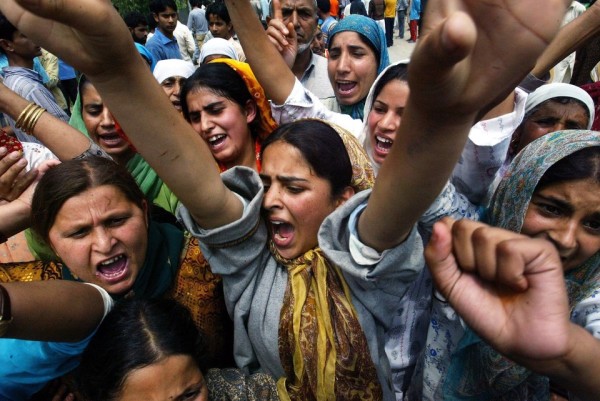
I can’t stop thinking about the flavour of that dinner, about the comfort that comes from the food from home. I also can’t stop thinking about Khurram Parvez’s wife, who does not know when she’ll share a meal with him again, and about all those women in Kashmir who are crying while preparing the favourite dish for their sons who have been killed in the past three months.

After 84 days of crackdown in Kashmir, winds of war blow between India and Pakistan. On both sides, armchair strategists invoke the power of a nuclear attack. Inebriated by nationalistic fascism, they do not consider that the border that separates them is only a fictional line traced on paper and that the possible consequences won’t stop at the frontier to ask for permission to cross.

Newspaper headlines and the occasional international attention, have used this chance to concentrate on the abstract dimension of the conflict sweeping aside what this actually means for the people. Yet again Kashmir is discussed as an expanse of land on either side of a line drawn on a map rather than as a land that belongs to a people who has been fighting for decades for the right to decide for themselves and their future. The abstract geopolitical discussion becomes the excuse to ignore that the armed forces destroyed the yearly apple harvest and burnt the cultivated fields; to look away from the seized ambulances, the night raids and the undiscriminated arrests.

How many more empty places at the dinner table, how many more meals full of absence are going to be needed before we recognise that the right to self-determination is inviolable and sacrosanct? How many more mothers will have to cry for the loss of their sons before we understand that violence and brutality will not eradicate the quest for freedom?

Unknown's avatar

A tavola – Pensando al Kashmir

gynaikes-diamartyrontai-03-600x401

Due settimane fa preparavo la cena: pasta col sugo d’agnello come da tradizione abruzzese e doon chettin, una salsa di noci tipica del Kashmir. Volevo che a tavola ci fosse tanto il sapore delle sue montagne che delle mie: sapori ruvidi che scaldano il cuore.

Quella sera, dopo cena, siamo venuti a sapere che avevano arrestato (con accuse prive di giustificazione legale) Khurram Parvez, un attivista per la difesa dei diritti umani che da anni lavora per denunciare la brutalità di cui è vittima inascoltata la gente del Kashmir. Il giorno prima di essere arrestato, gli era stato impedito di imbarcarsi sull’aereo per Ginevra dove avrebbe dovuto partecipare alla riunione della Commissione per i Diritti Umani delle Nazioni Unite.

E’ da quella sera che continuo a pensare al sapore di quella cena, al conforto del cibo di casa, ma anche alla moglie di Khurram Parvez che non sa quando potrà condividere di nuovo un pasto con lui e a tutte quelle donne che in Kashmir in questi giorni piangono mentre preparano il piatto preferito dei propri figli che sono stati uccisi in questi tre mesi.

Dopo 84 giorni di scontri ininterrotti in Kashmir, tra India e Pakistan tirano venti di guerra. Da entrambe le parti, gli strateghi da salotto cantano le lodi di un attacco nucleare. Inebriati di nazionalismo fascista sembrano non considerare che il confine che li divide è una linea immaginaria tracciata sulla carta e che le possibili conseguenze non si fermano a chiedere il permesso di varcare la frontiera.

I titoli dei giornali e la poca attenzione internazionale hanno raccolto al volo l’occasione per concentrarsi sulla dimensione astratta del conflitto lasciando passare in secondo piano quello che questo scontro significa per la gente. Ancora una volta il Kashmir ritorna ad essere discusso come uno spazio conteso al di qua e al di là di una linea sulla mappa invece che come il luogo di appartenenza di un popolo che da decenni lotta per il diritto a decidere per sé e per il proprio futuro. La discussione geopolitica diventa la scusa per distogliere lo sguardo dai raccolti di mele distrutti e dai campi coltivati bruciati dall’esercito, dalle ambulanze sequestrate, dai raid notturni e dagli arresti indiscriminati.

Quanti altri posti vuoti a tavola, quante cene piene di assenza ci vorranno prima che ci si renda conto che il diritto all’autodeterminazione è inviolabile e sacrosanto? Quante altre madri dovranno piangere i propri figli prima che ci si accorga che la violenza e la brutalità non riusciranno a sradicare il desiderio di libertà?