Unknown's avatar

Cultural Heritage, Conflicts, and the Map

On the 27th of July at 6 pm, I will speak as part of GeoBLR at the Mapbox office in Bangalore about Cultural Heritage, Conflicts, and the Map.

For the past 15 years I have been working in the promotion and revitalisation of cultural heritage and practices in countries in conflict. Mapping can be an important device to support locating archeological remains as well as living traditions.

The talk explores the challenges and opportunities of mapping in this context. It further addresses the issue of the value of (cultural) objects on the map. As there are many questions and no definitive answer, I hope that the presentation will turn into an engaging collective discussion.

Find the Mapbox office here on the map.

Unknown's avatar

Heritage and Politics in Kashmir

Amarnath-Yatra

This text was originally published on Kashmir Reader on the 6th of May 2016

Indian-occupied Kashmir is one of the most densely militarised corners of the world even though it is not officially a country at war. With over half a million troops stationed within its boundaries, the ratio between Indian armed forces and Kashmiri civilians is even higher than that between foreign military and civilian population at the peak of the American invasion of Iraq and Afghanistan. Despite the promise of a plebiscite, the region has been denied the right of self-determination and has seen the criminalisation of organised forms of dissent. Movement is regulated and the right to public space curbed under the pretence of maintaining law and order. In such a climate, the struggle over the control and definition of territory assumes a fundamental role. Within this context, therefore, the management and articulation of heritage assume a loaded political meaning. Whose history is preserved and promoted? By whom and through which political allegiances? What messages and agendas are championed through heritage? What are the meanings and reasons for reclaiming cultural roots through fabricated notions of tradition?
After the 2008 and 2010 uprisings, the Indian government has associated systematic repressive violence with a renewed public discourse on the beauty of Kashmir – a pristine landscape devoid of people. To strengthen its propagandistic effectiveness, the central government started providing financial incentives to tourism and pilgrimages as devices to normalise the conflict. This whole political apparatus is mostly articulated in religious terms with an emphasis on the indivisible sacrality of Indian land since ancient pre-Islamic times. The same strategy is adopted in relation to the border, where Hindu shrines are installed within the premises or in the vicinity of Army check-posts. These newly established religious sites, which become collective yet segregated places of worship, indirectly sanction the Army’s presence as well as the quintessentially Hindu nature of India as a country.
In the decades that followed Partition, India and Pakistan sat at the negotiating table several times to try and solve, among other things, their disagreement over the management of Kashmir. These talks did not achieve much, but sanctioned the “question of Kashmir” as aterritorial dispute – an empty land on a map where the issue was how – rather than if – it should be divided.Almost seventy years and several UN resolutions later, the situation has not changed. The articulation of the discourse is still framed in bilateral terms and continues to exclude the political voice of Kashmiris. Through a narrative that reinforces the idea that the “solution” for Kashmir has to come from India and Pakistan, Kashmiris themselves are sidelined and not acknowledged as equal, let alone indispensable, interlocutors. It is the fate of the land that is at stake, not the fate of those who belong to it. This unchanged perspective perpetuates the legitimacy of a “mystical” tone whereby Kashmir has come to symbolise the unquestionable wholeness of India as a country.
The first months of 2016 have seen open and rampant tensions around the oneness of India. The central government and its supporters are undeterred in their attempt to promote such unity and reinstate the intrinsically religious nature of Indian nationalist loyalty founded on the centrality of the myth of Bharat Mata. The reinforcement of the identification of the Indian land with the body of the mother collapses political and religious categories, turns the nationalist struggle into a religious duty and charges political claims for self-determination with an almost blasphemous and hence seditious connotation. Incidentally, by reciting the Bharat Mata ki Jai, the Indian Army finds a religious justification to their brutality: their mission is to protect the integrity of the land thus turning into the uncontested custodians of a dominant interpretation of belonging and heritage.
In order to be able to grasp the complexity of the notion of heritage and the intertwining between the sacralisation of the land and a sense of belonging in Kashmir, it is fundamental to grasp the relevance of the events of the 1990s and the displacement of the Kashmiri Pandits. Much of their pledge has been in fact appropriated by a chauvinist nationalist agenda and their desire to return to their homeland has been manipulated to reinforce the Hindu nature of the wholeness of India.
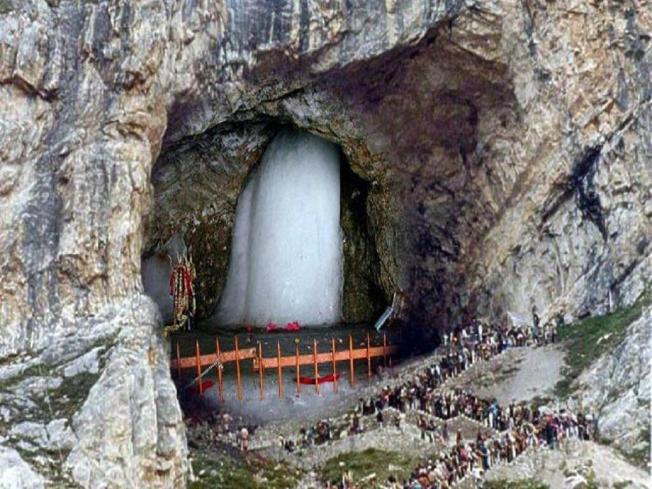
The recent revival of the Amarnath Yatra is an important example of how people’s mobilisation around cultural memorialisation can be used to interpret the political implications of the promotion of immaterial heritage. Located 140 kilometres North East of Srinagar, at an altitude of almost 4,000 meters, the cave of Amarnath, with its ice stalagmite, has been for centuries the site of religious pilgrimages. At the end of a steep climb in a pristine forest, the cave is blocked by snow for most of the year and it is only accessible for a short period of time during which pilgrims challenge altitude and asperities to pay their respect to the god. Legend has it that this is the secluded place that Lord Shiva chose to reveal to Parvati the secrets of immortality and of the creation of the Universe without being heard by any other living being. The cave is therefore revered and considered among the most important religious sites for Hindus. To corroborate its sacrality, it is believed that the ice stalagmite, which is thought to be waxing and waning in accordance to the moon cycles, is an embodiment of the Lingam, the phallic representation of Lord Shiva himself.
After being forgotten for centuries, the cave was “miraculously” rediscovered around the 1850s by Buta Malik, a wandering shepherd during the reign of Gulab Singh, the first Dogra ruler of Kashmir. The Maharaja was all too happy to encourage pilgrims to visit the site. Since its modern inception, the Yatra was a relatively small event that lasted no longer than fifteen days and included twenty to thirty thousand local Kashmiri Pandits. Between 1991 and 1995, the pilgrimage was suspended because of political instability; it was then resumed in 1996 after assurances by the militants that they would not harm the pilgrims. That year, however, a sudden change of weather and unexpected snowfall caused the death of more than 250 people. In response to this tragedy, the government decided to impose stricter regulations and set up the Shri Amarnathji Shrine Board (SASB).
The institutionalisation of the pilgrimage and the definition of the religious pre-requisites for the eligibility for the SASB represent a momentous turning point in the significance, promotion and political connotation that the Amarnath Yatra has acquired. It is after this transition, in fact, that the Sangh Parivar has shown a proactive interest in the pilgrimage, radically changing the narrative around it, thus escalating the politicisation of the initiative and hence its divisive nature.
Historian Eric Hobsbawm defines the process of the invention of tradition as an intentional way of using material from the past to serve novel purposes. This perspective resonates with an interpretation of heritage as a contemporary cultural use of the past, thus highlighting its political dimension. Hobsbawm’s definition of “invented traditions” can provide a useful framework for the understanding of the shift in meaning and political significance of the Amarnath Yatra. Even though there is no academic analysis of the Yatra, the debate around it is quite heated at the level of civil society. Positions are deeply polarised and mostly see a split between the government bodies, militant Kashmiri Pandits and Hindus from mainland India on one side, and moderate Kashmiri Pandits and Kashmiri civil society organisations on the other.
Over the course of several interviews with Kashmiri Pandits living both in the Valley and outside it, it emerged that there was a shared agreement around the preposterous notion of “reclamation of Kashmir” utilised to justify the scale of mobilisation around the Amarnath Yatra. In a phone interview, S. – who spoke on the condition of anonymity as he feared that his positions would upset the community – told me: “Amarnath has no relation whatsoever with Kashmiri Pandits, we as a community have nothing to do with the shrine. Those who will tell you that the tradition is ours and Muslims are trying to destroy it, hold false and biased views that are fuelled by their anger at the displacement they underwent. This reactionary narrative is not inherent to Kashmir, it is the result of Indianisation and the media are contributing to exacerbating a narrative that is more important to Indians than it is to us.”
Sanjay Tickoo, a Kashmiri Pandit social activist, who decided not to leave his native Srinagar during the 1989 exodus and has lived in the Valley his entire life, highlighted the deep religious connection with nature in Kashmir that characterises the Pandits’ religiosity and framed the relation with the Amarnath Yatra in the same terms. He also expressed his discontent towards the fact that the pilgrimage was taken over “by those who claim to be the real custodians of Hinduism”. While dissenting from the interpretations of the Yatra as a form of political oppression, Tickoo criticised the composition of the Shri Amarnathji Shrine Board where currently only one member, Bhajan Sopori, is a Kashmiri Pandit. He told me that this detail can be indicative of the politicisation of the pilgrimage and its disconnection from the Pandit community. Even though he did not seem too preoccupied with the implications of such adevelopment, his main concern had to do with the terrible environmental consequences the massive expansion of the Amarnath Yatra has caused over the years. He was highly critical of the great numbers and of the extension of the pilgrimage time from fifteen days to almost two months.
The effect that hundreds of thousands of people can have on a fragile mountainous environment is a general reason of concern. For many civil society activists, however, the ecological preoccupation is framed in broader political terms. Khurram Parvez, a member of the Jammu and Kashmir Coalition of Civil Society (JKCCS), lamented the detrimental effects that the Amarnath Yatra has on Kashmiri culture in terms of “its impact on our natural resources, its absolute lack of sustainability and the fact that it has become an alibi for an even further militarisation” Parvez was adamant in calling the Amarnath Yatra as a “military project run under the patronage of the State” and accused the SASB of being complicit with the State-sponsored narrative of reclaiming Kashmir.
As the BJP, RSS and other extreme right-wing Hindutva organisations appropriated the narrative around the Yatra, they started aggressive fundraising campaigns gathering large sums of money from diaspora Hindus across the world so as to be able to sponsor increasingly larger numbers of pilgrims entirely free of cost. This process changed dramatically the demography of the pilgrims who for the most joined the Yatra for opportunistic or ideological reasons. This tension is further heightened by the fact that pilgrims consider the Army to be there to protect them from aggressions by locals and terrorists alike, whereas for Kashmiris the military presence is an obvious disruption of their own lives.
Moreover, as the number of pilgrims grew exponentially, Kashmiri civil society organisations started denouncing the visible deterioration of the fragile Himalayan ecosystem around the cave. Scientific research shows the increase of waterborne diseases and water shortage in villages in South Kashmir during and in the immediate aftermaths of the pilgrimage. Yatris neither show any respect for the natural environment, by throwing all sorts of waste in the Lidder River and by defecating in the open, nor are they provided with the necessary facilities for a more considerate behaviour, despite it being one of the main tasks assigned to the SASB.
The tension between civil society organisations and the Shri Amarnathji Shrine Board reached a peak in May-August 2008 after the state government granted the transfer of 40 acres of forest land to the SASB for the construction of temporary structures for the accommodation of pilgrims. The announcement that this would represent a permanent transfer created public outrage as Kashmiris saw the transaction as a blatant violation of article 370 of the Indian Constitution. One of the provisions of such article is that only citizens of the state can purchase and own land in the Valley. Khurram Parvez defined the land transfer and the plan to build on forest land permanent structures to host pilgrims as “an ecological disaster and yet other manifestation of the Indian occupation.” Street protests erupted across Kashmir and clashes between civilians and Indian Army determined the withdrawal of the transfer. This in turn triggered a wave of unrest in Jammu – where the majority of the population is Hindu – with Hindutva parties and organisations were up in arms calling for a comprehensive agitation to fight and take back the land of Kashmir defined as “the paternal property of Hindus”.
The 2015 Amarnath Yatra counted more than 350 thousand participants and several deaths. The 2016 edition is scheduled to begin on the 2nd of July and will last for 48 days. In an ostentatious attempt to regulate the Yatra, the Shri Amarnathji Shrine Board announced that it will “only” allow 7,500 people per day on each of the two routes, therefore bringing the estimated attendance to 720,000 people. Violence and unrest are ebbing again in Kashmir following various episodes of brutal military responses to critical voices that dared questioning the indiscriminate acceptance of the oneness of India. In this climate, the forthcoming Amarnath Yatra may acquire further ideological connotations and be instrumentally used to serve chauvinistic Hindu nationalistic agendas. Leveraging on sentiments of belonging and the right to reclaim their own land through the construction of a well orchestrated invented tradition, the Amarnath Yatra is an important, if little known, example of the ways in which heritage movements can serve political purposes. Heritage activism in this particular case shows a dark and antagonistic side where the promotion of a carefully fabricated continuity to a selective sense of the past serves the Indian hegemonic discourse and indirectly legitimises both the presence of the Army and their deeds as custodians of the sacred unity of Bharat Mata.

Unknown's avatar

The architecture of conflicts

I will be part of a round table discussion on the 15th of June at The Triennale in Milan during the Milano Arch Week 2017.

Here are the details:

 15th June 2017 La Triennale – Giardino delle Sculture
16.30 / 17.30 TALK
THE ARCHITECTURE OF CONFLICTS:A DIALOGUE AROUND LANGUAGES,  TERRITORIES AND REPRESENTATION
moderato da Camillo Boano con:
* Eyal Weizman,
* A
mos Gitai,
* Francesca Recchia,
* Arcò,
* Vento di Terra

Hope to see you there

Unknown's avatar

Mondana Bashid

Un concerto a Manchester; una gelateria a Baghdad; un sabato sera di divertimento nel cuore di Londra; un crocevia trafficato, una manifestazione, un funerale a Kabul. Morti e feriti a decine se non a centinaia. E tutto questo senza contare quel che ci sfugge del resto dell’Iraq, della Siria, della Nigeria e di tutti i paesi che a stento fanno notizia.

Sono giorni difficili di fatica e paura. La chiusura e il sospetto sembrano la soluzione migliore: sicuramente quella più semplice. Alzare i muri e chiudere le porte. Girare le spalle a tutto ciò che è altro da noi. Ma si tratta della scelta peggiore: vuol dire cadere nella trappola, giocare alle regole del terrore, cedere al ricatto.

Manchester, Baghdad, Kabul e Londra rispondono a gran voce al rischio di scivolare nella bigotteria.

Stamattina nella metropolitana di Londra un cartello diceva: “Tutti possono cedere, è la cosa più facile che il mondo possa fare. Ma la vera forza sta nel tenere i pezzi insieme quando nessuno si stupirebbe del collasso.” E la gelateria di Baghdad ha riaperto cinque giorni dopo essere stata attaccata. E Kabul, con le code per donare il sangue e gli appelli all’unità e i dottori che hanno lavorato senza sosta e i giornalisti che non hanno mai smesso di essere in prima linea, continua a ricordarci il valore senza prezzo dell’umanità.

In Afghanistan, dove una cultura cortese dà ancora valore al rito di scambiarsi i saluti, ho imparato uno degli auspici più belli: Mondana Bashid – che tu possa non essere mai stanco.

Non penso ci sia niente di meglio da augurarci a vicenda in un momento del genere quando la stanchezza, la paura, lo sfinimento, il senso di impotenza rischiano di prendere il sopravvento.

Mondana Bashid ai cittadini di Kabul, ai medici di emergency, ai miei amici afghani che credono nel futuro.a tutti e ciascuno di noi; a tutti quelli che, ovunque si trovino nel mondo, hanno ancora il coraggio di continuare a sperare e lavorano per rendere le cose un po’ migliori.

Unknown's avatar

Mondana Bashid

A concert in Manchester; an ice cream parlour in Baghdad; a fun Saturday evening in the heart of London; a busy crossroad, a demonstration and a funeral in Kabul. Tens if not hundreds of people dead or wounded. And all this without considering what happens in Syria, in the rest of Iraq, in Nigeria as it doesn’t make the news any longer.

These are days full of fear and exhaustion. Rejection and suspicion seem to be the easiest solution: closing all the doors; building walls, turning our backs to everyone who’s other than us. It is in fact the worst choice because it means to fall in the trap, to play by the rules of terror, to accept to be blackmailed.

Manchester, Baghdad, Kabul and London are shouting back at the peril of slipping into bigotry.

This morning on a signboard on the London tube it was written: “Anyone can give up, it’s the easiest thing in the world to do. But to hold it together when everyone else would understand if you fell apart, that’s true strength.” And in the ice cream parlour in Baghdad, they went back to work five days after being hit. And Kabul – where people queued to give blood and appealed to unity and doctors worked with no rest and journalists stayed strong on the frontline to tell their story – reminds us the immense value of humanity.

In Afghanistan, where a courteous culture still gives value to the ritual of exchanging greetings, I learnt one of the most beautiful wishes: Mondana Bashid – may you never be tired.

I don’t thing there is anything better we can wish each other in a time like this when tiredness, fear, exhaustion and helplessness risk to take over.

Mondana Bashid to the citizens of Kabul, to emergency‘s doctors, to my Afghan friends who still believe in the future. Mondana Bashid to each one of us and to all those, no matter where they are in the world, who still have the courage to hope and to make things a little better.

Unknown's avatar

Who cleans the city?

After the IS attack at a demonstration in Kabul on the 23rd of July 2016, I wrote a tribute to those who clean the city afterwords and allow us to move on with dignity. We all thought that it was worst attack since 2001 – until yesterday when Kabul was hit again. The figures of the attack are mind-numbing: 93 killed and more than 450 injured.

Today, sadly, my thoughts go again to those who clean the city.

*

The day after is always difficult.

Yesterday’s suicide attack has been the worst in Kabul since 2001–the victims were all civilians, all young: a terrible blast for the already fragile heart of the city.

With the sombering and heavy attitude that characterizes a national day of mourning, the city this morning woke up and went on with its business as usual. Kabul is a strong city, a city that reacts and doesn’t break. Her formidable resilience is one of the first things one discovers and falls in love with upon moving here. Life goes on no matter what, you roll your sleeves and move on–this is a way of looking at the world that is a profound source of inspiration.

This morning I woke up with a thought that I still can’t get out of my head: I keep thinking about those who clean the city, about those who work before day breaks to remove all the traces of a horror such as yesterday’s.

It is well known that Kabul’s strength is in her ability to start afresh every time, but we don’t know anything about those who make it possible, about those who scrub the blood off the asphalt, who collect what remains, who hose away all that has to disappear.

We probably owe them the fact that we can move on, to these silent restorers of normalcy; to those who, in Kabul or Baghdad or Srinagar, have the task of disguising smells, of remodelling the facade of the ordinary, of hiding the traces of traumas that are too difficult even to imagine.

I don’t know who they are, I don’t know their faces and I wonder what they may think – a prayer or a curse–while they clean up surrounded by the night. I thought, however, it was important to write about them – to exorcise that obsessive thought, but also to pay my respects to those who, probably without knowing, allow us to look ahead into the future.


Unknown's avatar

Chi pulisce la città

Ho scritto un tributo a coloro che puliscono la città dopo gli attentati, in occasione della bomba del 23 luglio 2016 a Kabul. La loro presenza silenziosa ci dà la possibilità di guardare avanti con dignità.

Dopo l’attentato terribile di ieri in cui i morti confermati sono 93 e i feriti piu’ di 450, il mio pensiero torna di nuovo a loro.

l giorno dopo, si sa, è sempre difficile.

Quella di ieri è stata, per Kabul, la strage peggiore dal 2001 – tutti civili, tutti giovani, un colpo al cuore già fragile della città. Con la sobrietà che caratterizza un giorno di lutto nazionale, la città stamattina si è svegliata e ha ricominciato a vivere dopo un pomeriggio passato col fiato sospeso. Kabul è una città forte, una città che reagisce e non si lascia piegare. La sua resilienza formidabile è una delle prime cose che si scoprono quando si viene a vivere qui. La vita va avanti, nonostante tutto e tutti: ci si rimbocca le maniche e si guarda avanti – un modo di vedere il mondo che è una profonda fonte d’ispirazione.

Stamattina mi sono svegliata con un pensiero fisso che non riesco a togliermi dalla testa: continuo a pensare a chi pulisce la città, a quelli che in silenzio entrano in azione prima dell’alba e ripuliscono la città dalle tracce di un orrore come quello di ieri. Si dice che la forza di Kabul sta nel fatto che riesce sempre a ricominciare, ma non si dice mai niente di quelli che lo rendono possibile, di quelli che strofinano il sangue via dall’asfalto, di quelli che raccolgono i resti e con le pompe lavano via tutto quello che deve scomparire. E’ a loro che probabilmente si deve il fatto che si possa andare avanti, a questi silenziosi restauratori della normalità che, a Kabul come a Baghdad o a Srinagar, hanno il compito di mascherare gli odori, restaurare il sipario dell’ordinario, nascondere le tracce di traumi difficili da immaginare.

Non ho idea di chi siano o che faccia abbiano, non ho idea di che cosa possa passare loro per la testa, se una preghiera o una bestemmia, mentre strofinano avvolti dalla notte. Ho pensato che fosse importante scrivere di loro – per esorcizzare un pensiero ossessivo e per rendere omaggio a chi, forse senza saperlo, ci rende possibile guardare al futuro.

Questo testo è stato pubblicato su Q Code Mag

Unknown's avatar

To Resist is to Exist

images50 years ago, the revolutionary masterpiece The Battle of Algiers by Gillo Pontecorvo won the Golden Lion at the Venice Film Festival. To mark the anniversary, the film has been restaured and CG Entertainment launched a campaign to published this new edition (in Italian). To support the initiative, they asked me to engage in a conversation with this great work of art. My thougths are below and this is the link to support the campaign.


We live in dark times, in a precarious equilibrium between fear and inurement. The big engine of the empire huffs and puffs, hit at its core by lone wolves and organised terrorists. The chasm between us and them grows wider, defined by shortcuts and superficial understandings that seem convincing because are worded in the incontestable language of reassuring populism. We live in dark times that are nurtured by historical courses and recourses: History does not teach, human kind does not learn from past mistakes, the thirst for revenge is more satisfying than the desire for transformation. The dystopia of the present builds isolating and fragmentary geographies, designed in the negative and founded on divisions. In this grim picture, instead of the possibility of encounters, the only thing that seems to multiply are separating devices and mechanisms of exclusion: concrete walls, thousand-eyed drones, coils of barbed wire.  

Read the full article on With Kashmir 

Unknown's avatar

Resistere è esistere

images

50 anni fa, La Battaglia di Algeri di Gillo Pontecorvo vinceva il Leone d’Oro alla Mostra del Cinema di Venezia. In occasione dell’anniversario, il film è stato restaurato e CG Entertainment ha lanciato una campagna per pubblicare questa nuova edizione. In sostegno all’iniziativa, mi hanno chiesto di raccogliere dei pensieri in risposta a questa grande opera d’arte.
Il testo
è qui di seguito e questo è il link per sostenere la campagna.

Viviamo tempi cupi, in equilibrio precario fra la paura e l’assuefazione. La grande macchina dell’impero sbuffa in affanno, colpita al cuore da lupi solitari e terroristi organizzati. Il guado tra noi e loro si allarga, un guado definito da scorciatoie spesso solcate da conoscenze superficiali che sembrano convincenti perché elaborate nella lingua incontestabile del populismo rassicurante. Viviamo tempi cupi che sono alimentati da interminabili corsi e ricorsi di vichiana memoria: la storia non insegna, il genere umano non impara dagli errori del passato, la sete di vendetta sazia più del desiderio di trasformazione. La distopia del presente costruisce geografie frammentarie e isolazioniste, disegnate al negativo e fondate sulla divisione. In questo quadro sconfortante invece della possibilità d’incontro, l’unica cosa che sembra moltiplicarsi sono i dispositivi di separazione e i meccanismi di esclusione: muri di cemento, droni dai mille occhi, bobine di filo spinato.

Cinquantadue anni fa, Gillo Pontecorvo girava La Battaglia di Algeri, un film rivoluzionario senza tempo che – raccontando la storia della resistenza algerina e dei primi passi del movimento di liberazione nazionale che hanno condotto al drammatico, ma necessario processo di decolonizzazione – parla al presente con una contemporaneità stupefacente.

Cambiano i termini storici, ma la sostanza resta la stessa. Gli oppressori, i fascismi, i colonialismi passati e presenti reiterano triti argomenti per perpetuare la propria esistenza e asserire un’idea immutabile di passato che confermi la legittimità del proprio privilegio. Il paternalismo benevolente del potere, l’infantilizzazione dell’altro, la discriminazione sulla base del colore della pelle e della religione sopravvivono alla loro stessa stupidità.

In risposta ad uno status quo ingiusto e apparentemente immutabile, la resistenza – politica, civile, disobbediente, armata – continua a vivere rivendicando il diritto all’autodeterminazione, ad un accesso equo alle risorse, alla possibilità di essere gli autori della propria storia.

L’Algeria del 1957 è la Palestina dell’Intifada, è il Kashmir dell’estate di sangue del 2016, è la protesta degli Indiani d’America nella Riserva di Standing Rock.

Qualche tempo fa, in una conversazione i cui toni sono presto diventati animati, un amico mi ha invitato al realismo dicendo che di fronte alla violenza del potere è dovere dell’oppresso accettare la disparità delle forze ed accettare un compromesso. Mi ha detto che devo imparare a distinguere fra l’idealismo e la realpolitik: è tempo di crescere e guardare in faccia la realtà, visto che il sacrificio per la libertà non hai mai portato nessun frutto.

E’ vero, mai come oggi – in giorni di barconi alla deriva, campi profughi delimitati da reti elettrificate e diritto al movimento negato sulla base della religione – è tempo di crescere e guardare in faccia la realtà prendendo atto del fatto che siamo costantemente stimolati a scommettere sulla sopravvivenza e di dimenticarci della nostra esistenza.

Resistere è esistere – vivere a pieno in nome dell’equità e della libertà proponendo un modello diverso dall’oscurantismo che in nome di un dubbio beneficio immediato dissecca le radici dei diritti, del valore della diversità, della necessità di esprimere il proprio sé al di là di categorizzazioni e incasellamenti.

In La Battaglia di Algeri nel sesto giorno dello sciopero generale organizzato dal Fronte di Liberazione Nazionale, il gendarme francese al megafono sollecita la popolazione locale ricordando loro che è la Francia ad essere la loro patria ed è la Francia a sapere ciò che è meglio per il loro futuro e non i “terroristi” che cercano di manipolarli.

In un momento di grande poesia, il piccolo Omar, sgattaiolando tra il filo spinato, riesce a sottrarre il megafono ai Francesi e grida alla folla: “Fratelli algerini, fratelli, coraggio, resistete. Resistete. Non ascoltate quello che vi dicono. L’Algeria sarà libera.”

E’ con l’innocenza di questo bambino, un’innocenza che sopravvive nonostante la guerra, che dobbiamo guardare al futuro, alle potenzialità di un domani non omologato, tenendo stretto il diritto sacrosanto a esistere e resistere.

Unknown's avatar

A good person

The last few weeks have been quite difficult and emotionally exhausting. I went through a rough patch and ended up being face to face with the tangible risk of becoming the person I don’t want to be: impatient, detached and surrounded by a big, black cloud of bad mood.

However trite it may sound, it proved to be true that you need to be confronted by darkness in order to recognise the light.

The result of the exhaustion of the past days has been in fact that I finally understood that my main objective in life is to be a good person. It may sound naive, but in this historical conjuncture I believe it may turn into a radical political choice: not giving in to fear and suspicion, keeping a curious, open and allowing attitude.

I think such a choice may represent the sole root to cultivate in order to transform our social dimension and contribute in a constructive manner to rethinking the sphere of the collective. This is perhaps the only way to emancipate ourselves from economic and political models that channel us towards a grey and faceless uniformity.

I am thinking about my parents’ decision to retreat to a simple life, I am thinking about my sister’s professional choices based on respect and inclusiveness irrespective of visible and invisible differences.

The investment on integrity, both at the level of the person and that of the practice, is the only way to survive these terrible times and to resist the vulgarity of shoutings, spitted hate and violence.

We were discussing it last night with Sandi Hilal in one of our very special transoceanic conversations. The great challenge for our future is to keep cultivating the courage to leave the doors of our houses open, to keep investing on hospitality and exchange. The difficult step is to realise that this personal choice becomes a civic responsibility, that the way we choose to live our today has immense political repercussions.

The biggest ambition is therefore to be a good person – while regaining the courage not to worry about being out of fashion.

(Dedicated to Sandi Hilal)