Unknown's avatar

The Little Book of Kabul – Launch in Kabul

kiccovich's avatarThe Little Book of Kabul

The Little Book of Kabul is now out in the world.It has reached many houses and hopefully offered a glimpse of unexpected beauty.

In the next few weeks, Lorenzo and I will be travelling to present the book and tell the story of its making.

This last phase of our journey – obviously – began in Kabul.

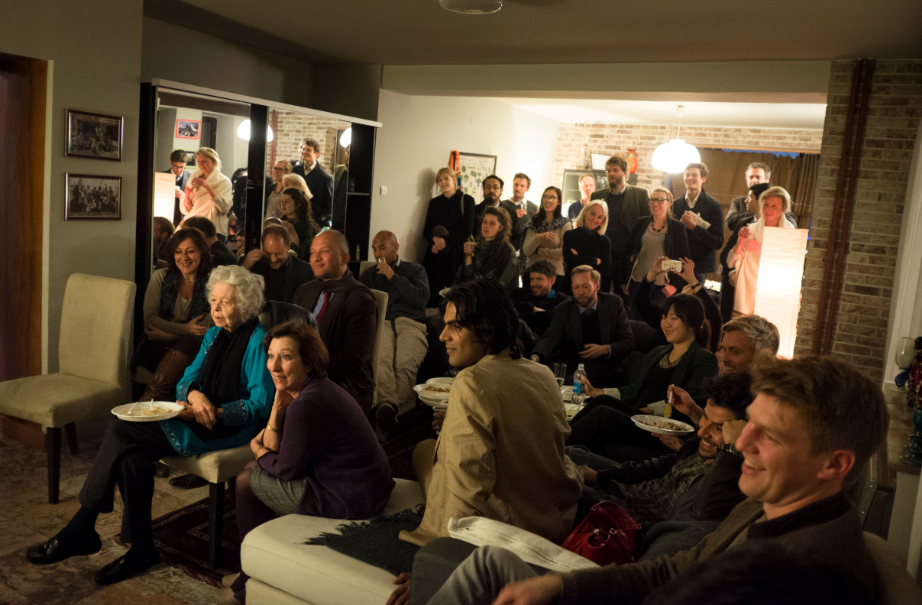
We had the great privilege of being hosted by Margherita Stancati and Nathan Hodge at the Wall Street Journal for an evening of discussion and celebration.

Screen Shot 2014-11-07 at 2.35.09 PM

*Photo Credit: Joel van Houdt *

It was beautiful to share some of the backstage stories with old friends who have followed our adventure since its inception and new friends who now walk the same streets we recount in the book.

The incredible amount of affection that surrounds The Little Book of Kabul never ceases to surprise us and we are deeply grateful for that.

View original post

Unknown's avatar

The Little Book of Kabul is on TIME Lightbox

Photo credit Lorenzo Tugnoli

Photo credit Lorenzo Tugnoli

Lorenzo and I met Mikko Takkunen at Visa pour l’Image in Perpignan.

It was a beautiful encounter, Mikko gave us and our book time and attention. We were happy to have met someone with a genuine passion for photography and an unbiased curiosity.

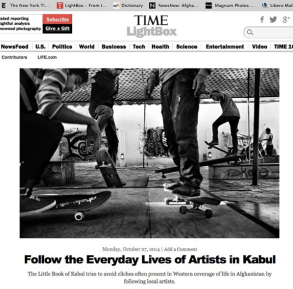
We are grateful that from that meeting TIME Lightbox decided to feature The Little Book of Kabul.

You can read the review: Follow the Everyday Lives of Artists in Kabul here.

Unknown's avatar

A conversation with Trevor Paglen

Francesca Recchia: We share a passion for geography and maps. A great part of your artistic and conceptual work has been concentrated on what may be summarised as mapping the invisible. How do you inhabit such an oxymoron?

Trevor Paglen: Most of the work I do is self-contradictory: I make images that tend to be quite abstract and at the same time, I do a huge amount of empirical work to arrive at those abstractions. I’m not so much interesting in ‘mapping’ the invisible so much as trying to understand what invisibility itself looks like.

FR: Photography is an important element in both your research process and its final outcomes. Whether buildings, documents, satellites, or airplanes, most of the subjects of your photographs are classified, but you always make a point in shooting them from public land. In this historical phase of hyper-control, is this a way of reclaiming our right to the common, our right to a free public domain?

TP: I’ve long thought of photography as a performance. To take a picture or to make an image is to also insist on one’s right to make an image. From the earliest photos I took of classified military installations, I almost thought of them as documentation-of-performances.

FR: Your work seems to reside on the fine line between the absurd and the sublime. Is that a deliberate quest for a new kind of poetic space of artistic creation?

TP: What I want out of art is things that help us see who we are now. To me the world looks like a combination of the absurd and the sublime.

FR: The Last Pictures Project is an extremely fascinating, visionary endeavour. Almost a sci-fi version of the romantic explorers who would go and discover new worlds, connecting cultures and perceptions of the world. Have you ever felt like an inter-galactic Indiana Johns?

TP: The Last Pictures is very much about the conjunction of the absurd and the sublime. The project started when I realized that certain kinds of satellites (geostationary) are in orbits so far from earth that when they power-down and die, their inert hulls remain in space, essentially forever. Billions of years – they are probably by far the longest-lasting things humans have ever made, transcending even the deep-time of geology and encroaching on the time of the cosmos. The Last Pictures is a project that’s trying to think through the contradictory moment in time we find ourselves living in. We live in a time where we can make things that last as long as the solar system, but can’t seem to develop even short-term policies to avert the economic and environmental crises that we collectively face.

FR: What is the sort of human kind that emerges from the selection of photos that you have chosen to send travelling in the outer space with The Last Pictures Project?

TP: The Last Pictures is decidedly not meant to be something as ludicrous as a ‘portrait of humanity’ or some crap like that. It’s a montage of deliberately obtuse images that, at least for me and my collaborators, speak to deep anxieties about the idea of “progress” and the direction that the world is going.

FR: American forester and environmentalist Aldo Leopold said: “Conservation is a state of harmony between men and land.” Can your interest in space junk or projects like The Other Night Sky be interpreted as a way to explore new forms of cosmic harmony? Or new frontiers for the semantics of eternity?

TP: I’m suspicious of the idea of harmony, which to me implies a kind of stasis that I don’t think you actually can ever find in nature or history. When I’m looking at spy satellites or space junk, I’m perhaps invoking traditions of looking at the sky and seeking deeper truths about the origins of the universe and its ultimate fate. But where someone with a background in observational cosmology finds clues to the early universe in the images of a Hubble Space Telescope, I look at the night sky and tend to see all of the secret machines that are spying on the earth below. Not incidentally, the Hubble Space Telescope is itself essentially a re-purposed spy satellite.

FR: From a non-practicing academic to a non-practicing academic: your work seems to address the issue of knowledge production from a perspective that questions the prominence of the logos. You create and unpack complex notions, using languages that go beyond the verbal. You seem to make a pretty strong statement about the potentials of the visual as an independent form of knowledge production.

TP: Thanks.

FR: Your artistic work is the result of extensive and meticulous investigative research. Do you think that the fact that after all it is only just art allows for a protected space of enquiry and a greater freedom to expose sensitive geopolitical issues?

TP: Not really. I think that it’s very difficult to be a good artist, especially in dealing with politically charged issues. Making art just doesn’t work the same way as journalism or scholarship. A lot of scholarship is pretty formulaic. With art you have to invent your own forms themselves, which is really hard.

FR: Can you tell me a secret?

TP: The government is spying on you. (Like many secrets, this one is well-known but is still officially a secret).

Unknown's avatar

Enciclopedia delle Donne

Tempo fa, Malavika Velayanikal ha scritto di me per l’Enciclopedia delle Donne. Molto è cambiato, il viaggio si è allungato, ma parte della storia resta.

Photo Credit: Selvaprakash L.

Photo Credit: Selvaprakash L.

Francesca Recchia ha attraversato mezzo mondo, spinta dalla passione per la conoscenza. Forzando sia letteralmente che figurativamente molti confini, i suoi vagabondaggi l’hanno portata in posti insoliti e spesso pericolosi.
Francesca ha sempre infranto convenzioni e stereotipi – come quando, da adolescente, è stata la prima rappresentante d’istituto di sinistra, interrompendo la lunga tradizione politica di destra del liceo di Avezzano, in centro Italia; oppure quando, molti anni più tardi, ha fatto conoscere agli studenti della University of Kurdistan Hawler, in nord Iraq, le potenzialità del pensiero critico e di forme alternative di dialogo. Lascia il suo paese d’origine subito dopo gli anni “molto” politici del liceo. Non è stata solo la scelta di laurearsi in Conservazione dei Beni Culturali a spingerla a Venezia, dalla parte opposta dell’Italia; trasferirsi a Venezia è stato perciò per lei un modo di ricominciare da zero: «dove nessuno mi conosceva e io potevo davvero capire chi fossi e che cosa volessi». Questa è per lei una costante: «Mi sento sempre un po’ fuori posto, cerco continuamente cose diverse e finisco sempre per essere un po’ più fuori posto, ma un po’ più contenta di prima».
In ambito accademico la sua irrequietezza ha acquisito nel tempo significati diversi: non è mai stata capace di dedicarsi ad una sola disciplina, di studiare con un solo professore o in una sola università – «intellettualmente non sono monogama», dice.
Nei primi anni di università hanno cominciato a prendere forma le sue convinzioni intellettuali: l’idea che la conoscenza non sia unidirezionale e che l’intelligenza sia un prodotto collettivo, ha giocato nel tempo un ruolo importante. Un’idea potente che, in realtà, non molti accademici condividono. Per la tesi di laurea (1999) ha mescolato arte e sociologia, scrivendo sull’arte contemporanea e i suoi devianti: l’esplorazione della linea sottile fra il genio e la follia non ha raccolto il consenso di tutti i professori. La sua relatrice, Giuliana Chiaretti, è stata la sola a sostenerla e ad incoraggiare il suo approccio interdisciplinare.
Il Master in Studi Visivi al Goldsmiths College di Londra le ha cambiato la vita grazie all’incontro con Sarat Maharaj, un professore sudafricano di origini indiane.
Qui, ancora una volta, ha rotto gli schemi organizzando un gruppo di discussione alternativo aperto a tutti, in cui artisti e critici potevano incontrarsi, cosa fino a quel momento piuttosto rara. Francesca, in questa fase del suo percorso intellettuale, ha cominciato a mettere in discussione le dinamiche di produzione della conoscenza ed è così che gli Studi Postcoloniali e Subalterni hanno colpito la sua attenzione.
Quando Londra sembrava praticamente perfetta per lei, ha deciso di spostarsi di nuovo: l’Italia era nel bel mezzo della “fuga dei cervelli” e tornare le è sembrato un dovere morale.
Con una borsa di studio consegue il dottorato di ricerca in Letterature, Culture e Storie dei Paesi Anglofoni presso l’Università L’Orientale di Napoli. Dopo le ondate di migrazioni successive alla seconda guerra mondiale, l’idea di Europa è cambiata e il “noi” e gli “altri” hanno preso all’interno dei suoi confini una nuova forma.
Francesca ha subito il fascino della trasformazione di questa idea di alterità e ha deciso di scriverne per la sua tesi, utilizzando la città di Londra come caso studio.
Infrangere i muri dell’arroganza intellettuale non rende la vita semplice a nessuno, e così è stato anche per lei. Con i suoi professori di Napoli ha sempre avuto difficoltà ma “fortunatamente” Sarat Maharaj è tornato nella sua vita, invitandola a lavorare per Documenta 11, la prestigiosa mostra che segna ogni cinque anni i paradigmi dell’arte contemporanea. Da lì ha cominciato a lavorare con multiplicity, un gruppo interdisciplinare di ricerca con cui ha condiviso, dice: «l’interesse per come cambiano le città e per il modo in cui le persone e i luoghi interagiscono». A Documenta, il gruppo di cui faceva parte aveva un mantra – Sbatti contro il muro e impara ad abbracciare il tuo destino – questo è stato da allora un motto che ha continuato ad accompagnarla visto che l’unico modo in cui riesce ad imparare è sempre per la strada più difficile. Ha viaggiato con diversi gruppi di ricercatori trovando opportunità per fare lezioni, studiare ed esplorare posti quali il Pakistan, la Palestina, il Kashmir, l’Oman, la Tunisia oltre a diversi paesi europei, sempre esercitando la sua non comune abilità di interpretare patterns insoliti, di unire punti di disegni invisibili.
«Mi ha insegnato l’umiltà intellettuale e la consapevolezza che la curiosità non ha mai fine!», dice di lei Sir Peter Hall, uno dei padri fondatori dell’urbanistica europea. Con lui Francesca ha completato il post-dottorato alla Bartlett School of Planning della University College of London.
Grazie alla collaborazione nel 2008 con TU Delft, in Olanda, con il gruppo Urban Body – che si interessa di sviluppo urbano mettendo al centro della prospettiva di ricerca il corpo umano – Francesca Recchia è arrivata a Bombay, in India, dopo analoghe esperienze a Pechino e Madrid.
«Credo che l’intelligenza e la conoscenza siano processi condivisi, le mie lezioni non sono quasi mai frontali, ma fondate sulla discussione».
Lezioni e conferenze nel tempo l’hanno portata a Venezia, Milano, Delft, in India, in Pakistan, in Palestina… Francesca ha sempre pensato all’insegnamento come ad un’attività politica – un’azione politica intesa nel senso della possibilità di produrre cambiamento anche se fino a quel momento la sua esperienza sembrava mettere in discussione le sue idee: «Ero a disagio, mi sembrava di essere pagata per prestare un servizio.» Per lei, insegnare l’importanza del pensiero critico, del dialogo, della discussione, dell’apprendimento democratico è sempre stato tanto rilevante quanto trasmettere i contenuti.
Il Kurdistan iracheno è in una fase di transizione verso la democrazia e la missione della University of Kurdistan Hawler è quella di combinare tradizioni locali e pensiero contemporaneo: cercavano un docente di sociologia urbana e a Francesca Recchia questa è sembrata una occasione perfetta: l’esperienza di quei due anni sta diventando un libro che testimonia la ricchezza di quell’incontro.
Francesca è tornata in India a luglio del 2010 dove ha lavorato per un periodo alla trasformazione radicale di un villaggio rurale prima di rimettersi di nuovo in viaggio. Il mondo è lì che chiama e lei è sempre pronta a rispondere.

Unknown's avatar

Virtual Kabul – Or, the unexpected joys of collaboration

A couple of weeks ago I was in San Francisco and had the great pleasure of meeting Nick Sowers.

Nick defines himself as someone who “constructs space with sound” and we soon found ourselves talking about space (obviously), cities, walking and everything urban. We talked about how sounds and noises influence the perception of our surroundings and the role they play in terms of memory and orientation.

That’s when I told him that I have written for The Little Book of Kabul  a musical score for a construction site. This piece was originally conceived as a fully fledged sinfonietta (that the amazing composer Giovanni Dettori checked for musical and compositional accuracy). For reasons of space it became a much shorter piece, but it is a fundamental part of the book anyway.

I had visited the construction site of what would become Rahim Walizada‘s Design Cafe in Kabul several times. I took notes and spoke to people, but then after a while I was at loss for stimuli: didn’t know how to interact with the place anymore and was getting pretty bored. I then decided to sit in the corner, listen and write down all the sounds I could hear, their intensity and where they were coming from. I didn’t have anything specific in mind back then, but when I went through my notes months later while writing the book, I realised it was an incredible opportunity to experiment with writing and explore different ways of describing spatial relations.

I told all this to Nick, we understood we spoke the same language and he invited me to join him in his sound studio and asked me if if was OK with him trying to make my musical score play. I was completely thrilled.

His studio is a remarkable little place where he set up a sound device that allows you to experience the three-dimensionality of space through sound. We didn’t have much time, but we played around and we could both feel that there something there that was worth chasing.

As we parted ways, Nick told me that he wanted to spend more time with those sounds and make something out of it. The idea made me really happy: there was the chance for my words to morph, to take body in a different shape and substance. I don’t think I could have asked for anything better.

A few days later, Nick got back to me and sent me his reinterpretation of my music score.

(You can read his take on our encounter here)

When my sister Susanna Recchia, who is a dance artist, listened to Nick’s piece, she immediately said that she would love to try and use it for one of her performances. This is yet to happen, but I am really hoping that it would soon become a further chance of collaboration and one new embodiment of experimenting with words, sounds and space.

Unknown's avatar

Art in Afghanistan: A Time of Transition

This piece was first publish in Muftah’s Special Collection Art of Pakistan and Afghanistan
Photo Credit: Lorenzo Tugnoli

Photo Credit: Lorenzo Tugnoli

2014 is slowly running its course. The International Security Assistance Force (ISAF) is expected to withdraw by the end of the year retaining only a very light foothold in the country. Many international donors are responding to the impending transition by reducing their work in Afghanistan as well. In the first few months of the year, attacks against foreigners increased, pushing many international NGOs to cut their presence on the ground to the bare minimum. Reduced military and humanitarian engagement means significantly less money flowing into the country. This will inevitably impact the sustainability of the nation-building process. Reduced cash inflow will have direct repercussions at various levels, affecting the maintenance of armed forces, the funding of salaries for government employees and NGO workers, the creation of new job opportunities, and the provision of basic security.

As is often the case, culture is among the first sectors to suffer funding cuts in times of crisis. To a certain extent, this is happening today in Afghanistan. On the one hand, culture is low on the agenda of donor priorities. This marks a radical change compared to the past few years, when cultural projects were supported, largely in an instrumental manner, to demonstrate the great achievements that resulted from Afghanistan’s occupation. On the other hand, in a revamping of the ‘winning hearts and minds’ counterinsurgency doctrine, donors are likely to continue using arts and culture to convey social and political messages – a subtle yet sneaky form of propaganda.

As Afghanistan transitions into a new phase, this is a prime opportunity to begin assessing the role international funding has played, and can continue to play in the country’s cultural practices.

International Donors in Afghanistan

In general, the centrality of capacity building and deliverables, combined with the fact that decisions are mostly made away from Afghanistan, have created funding priorities that focus on the start-up phase of projects instead of the less exciting work of institutionalizing initiatives. This has triggered a vicious circle of endless beginnings, and left limited funds for investing in long-term sustainability.

Commenting on this phenomenon, an Afghan friend once told me: “People come to teach us ABC, but we always stop at A because every time someone new comes, he starts again from A as he doesn’t expect that we can go any further.” The consequences of this attitude are potentially paralyzing, generating both dependency and irrelevance for many projects, including but not limited to those in the arts.

As an independent researcher living in Kabul, I have had the opportunity to collaborate with different organizations working in arts and culture in Afghanistan. In the past two years, I have directly witnessed these dynamics at the grass-root level, including the (not always so healthy) interactions between donors and practitioners.

Since culture is considered a relatively ‘harmless’ field, it is often experimental ground for scores of armchair experts and adventurous, self-appointed intellectuals to come and teach Afghans how to express themselves. One reads time and again of people who visit Kabul for a week or so to ‘discover’ Afghan art (or literature, or music, or poetry) and give voice to the ‘locals.’ They work to ‘enlighten’ the youth about how to emancipate themselves from an oppressive society, how to reject tradition, and liberate themselves from the burden of cultural backwardness. All this is often done under the incorrect supposition that Afghanistan is a homogenous, black and white place – demonstrating an appalling lack of knowledge (or worse, interest) in the actual conditions on the ground.

But this is also a two-way street. Beneficiaries sometimes take advantage of patronizing Western perspectives. They are happy to let the money flow, take what they can, and have at least some form of support for their activities.

In a recent interview, Afghan-American contemporary artist Aman Mojadidi commented on these circumstances:

There is the potential for cultural activities to move forward, but a lot of organizations have become dependent on international money and presence. If this deteriorates, will local cultural organisations have the motivation to keep going rather than continue to be psychologically and financially dependent? In practical terms, there would be no real obstacle: you are a group of artists and you do art. There is nothing to it: you don’t have to have funding. […] But when you immediately connect the creation of art with a donor, a project, a budget, then this is the sign of a very damaging mentality that can kill the potential of these cultural initiatives to move forward.[1]

To meet donor requests and attract more funds, events like thematic festivals, and photo, visual arts, or painting exhibitions, have multiplied. Many of these projects focus on topics of interest to Western funders, including women’s rights, children, peace or attempts at countering violence, drugs, and corruption. This has generated a significant amount of conceptual confusion between visual communication and genuine artistic expression, producing an abundance of mediocre, if not plain bad, art.

Locating Independent Arts and Cultural Organizations in Afghanistan

Over the past two years, I have invested a great deal of effort as an academic and practitioner in both understanding and responding to this situation. One of my greatest preoccupations has been to address – in theory as well as in practice – the agency that has been ignored or denied by Western aid practices.

In undertaking this work, my first step was to determine which of the existing cultural organizations would have enough commitment and determination to continue their work regardless of donor funding. I was not necessarily looking for antagonistic groups that were against the donor model, but rather for organizations that had a good balance of self-determination and external support.

In Afghanistan, I found quite a few organizations and artists that fit the bill. Whether in the field of visual arts, music, film, or poetry, there are a number of individuals and groups that have engaged in constructive but critical dialogue with the international funding system and are not fully dependent on these funders. Most of these genuinely independent initiatives lie below the radar, are very localized, operate offline, communicate in Dari or Pashto, and serve relatively small communities of people.

Among these is Berang Arts, a collective of young visual artists, who came together in 2009 after participating in the first edition of the Afghanistan Contemporary Art Prize. Investing their own funds, they managed to rent an apartment in Kabul and turn it into a contemporary art center – the first artist-led space in the country – with studio facilities for young artists and a small gallery for exhibitions. With time, the group has become a legitimate local partner for prestigious international cultural institutions, such as the Van Abbemuseum in Holland, the Prince Claus Fund, and documenta13.

Because of a lack of financial resources, artists and independent institutions tend to be protective of their achievements and ‘territory,’ making it difficult to have conversations with different groups engaged in similar activities. From both personal and formal conversations, I realized that the art’s community would benefit from more professional spaces that go beyond occasional workshops and vocational trainings. Many artists expressed a desire for more structured discussions around art theory, the history of art, as well as marketing and selling art to learn how to make a living through their practice.

In the last year, I have started working more closely with Berang Arts in an attempt to counter the damaging ‘ABC mentality’ and offer an alternative to the insularity of Kabul’s small cultural scene. Berang Art wanted to make the most of its space, and open itself up to artists coming from different backgrounds and working in various genres.

With small financial support from the Goethe Institute, the Agha Khan Trust for Culture, and the Dutch Embassy in Kabul, Berang Arts and I joined our resources and started working together to respond to shared needs and desires in Kabul’s art community. Together, we established an independent Contemporary Art Academy that offers young, but experienced artists advanced education in contemporary art history and theory, while also providing a personalized mentorship program to support them in their work.

Independent Cultural Organizations Are the Future

Berang Arts is a beautiful example of the great potential embodied by independent and self-sufficient arts and cultural organizations in Afghanistan. Groups like Berang foster advanced thinking about contemporary art, while operating strictly within a framework of local, cultural values and norms. They are proactive and independent, yet know how to relate to and benefit from the Western donor community.

Given their ability to navigate this world, these are the organizations that will likely come out the strongest once the country’s current financial and political transition has passed. This slippery terrain will work as a filter, helping good art and strengthening those groups and individuals whose commitment to arts and cultural practices in Afghanistan is rooted and genuine.


[1]Francesca Recchia, “Nationality, identity and art” Himal Southasian Special Issue Reclaiming Afghanisttan, Vol 27 No 1, 2014, p. 75.

Unknown's avatar

The Little Book of Kabul

Screen Shot 2014-08-13 at 4.51.14 PM

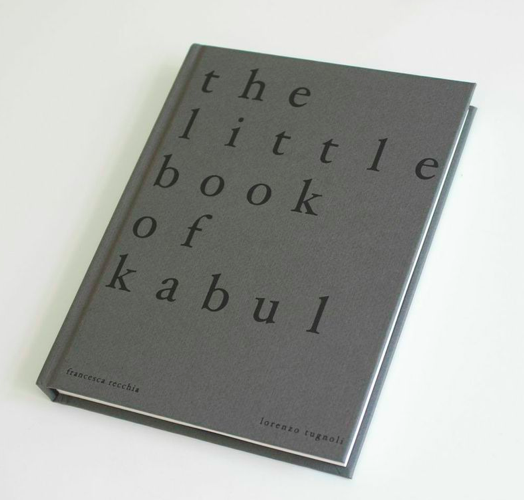
The Little Book of Kabul is a self-published book released in Agust 2014 in collaboration with the amazing photographer Lorenzo Tugnoli.

Made of short stories and black and white photos, the book is a portrait of the city of Kabul through the daily activities of a number of artists that we followed for more than a year.

The book is a limited edition of 500 signed and numbered copies.

The affection that surrounds this project is overwhelming and never ceases to leave me happily speechless.

The book can be purchased here.