Unknown's avatar

Oasi / Oasis

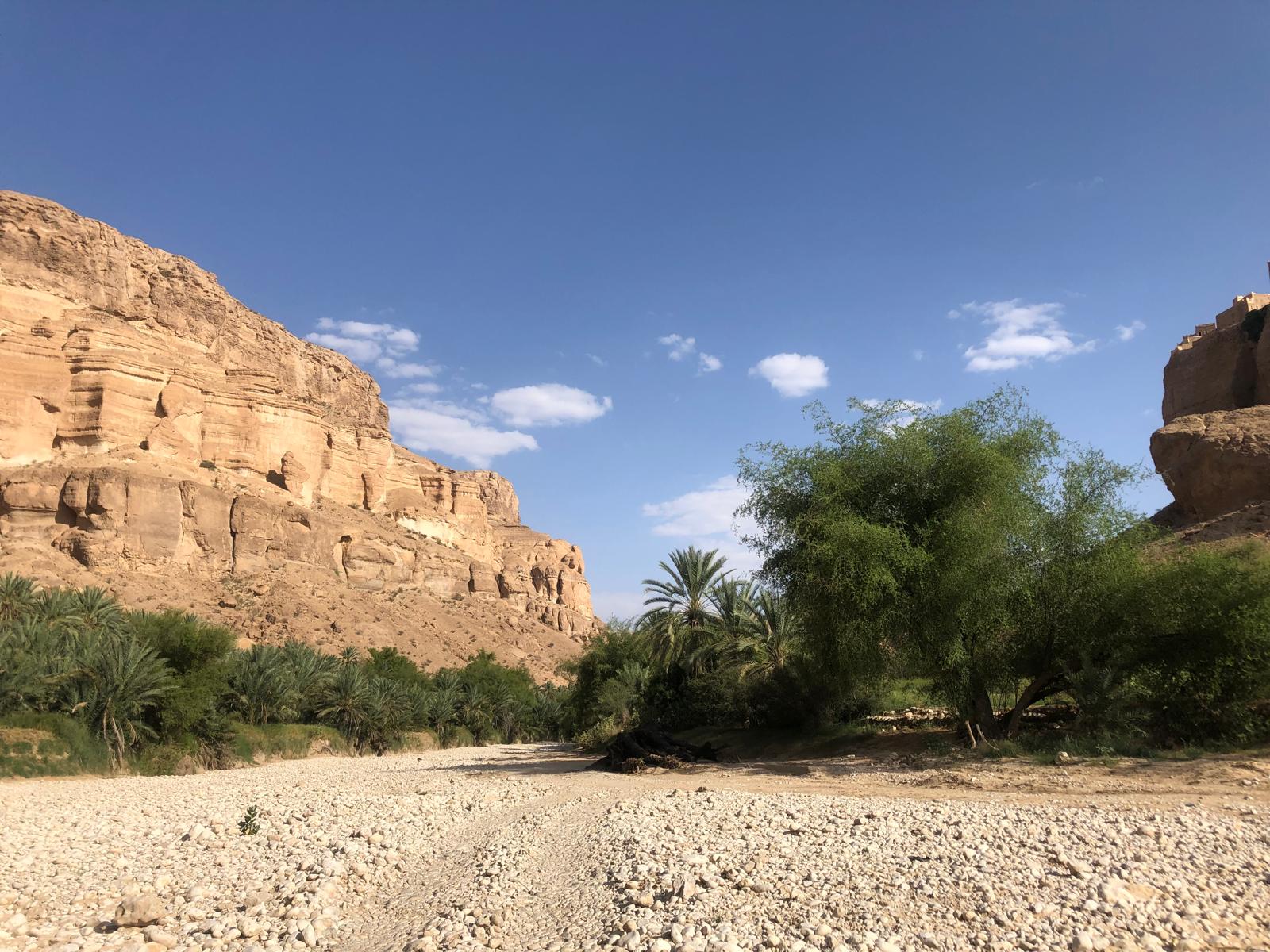
Yemen, 2023. Francesca Recchia

Con il mondo alla deriva, siamo barchette di carta trascinate dalla corrente

mentre uomini ingordi, senza scrupoli né vergogna, giocano a dadi con i nostri destini

Un orizzonte senza orizzonte lascia spiazzati e confusi

Le cicatrici profonde del genocidio smorzano il senso del futuro – per sempre effimero, per sempre evanescente

Ancorati al presente, resistiamo

Resistiamo al buio del mondo e a volte al nostro stesso senso di sconforto

Scossi dal senso di colpa per i rari momenti di sollievo, resistiamo

Resistiamo una resistenza fatta di piccole oasi

di momenti, persone, amori

di risate inattese

di abbracci stretti

di silenzi liberatori

Resistiamo una resistenza fatta di piccole oasi

la rete di salvataggio delle amiche

le pacche sulle spalle dagli amici

il tepore della famiglia

la sorpresa dell’amore

Resistiamo una resistenza fatta di piccole oasi

oasi che insegnano che bisogna ancora fidarsi

oasi che insegnano a tendere la mano

oasi che si fanno portatrici di possibilità

oasi che si fanno incubatrici di speranza


With the world adrift, we are paper boats carried by the current

while greedy men, unscrupulous and shameless, gamble with our destinies

A horizon without horizon leaves us bewildered and confused

The deep scars of genocide muffle our sense of the future – forever ephemeral, forever evanescent

Anchored to the present, we resist

We resist the darkness of the world and sometimes also our own sense of despair

Shaken by guilt for the rare moments of relief, we resist

We resist a resistance made of small oases

of moments, people, loves

of unexpected laughter

of tight hugs

of liberating silences

We resist a resistance made of small oases

the lifeline of girlfriends

the pats on the back from friends

the warmth of family

the surprise of love

We resist a resistance made of small oases

oases that teach us to still trust

oases that teach us to extend a hand

oases that become bearers of possibility

oases that become incubators of hope

Unknown's avatar

End of summer – Fine estate

The oleander did not survive the passing of time.

I need to find a plants’ cemetery

to bury it along with evaluation mistakes.

The earth in Autumn broods

reflections and transformation.

Take time to think

so as to grow:

to adjust more than change

to consolidate what is real and important

to trim down what is superfluous

to eliminate what is damaging.

At the end of summer

the smell of wind and the tone of light

transform and take on

shades of underwood:

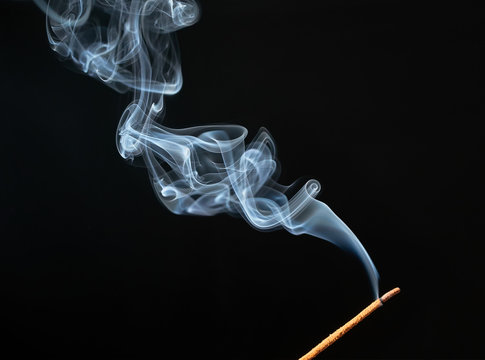
I absorb their warmth

along with incense smoke.

A foot to travel

and a foot to stay.

***

L’oleandro non è sopravvissuto al passare del tempo.

Devo trovare un cimitero delle piante

dove seppellirlo insieme agli errori di valutazione.

La terra in autunno cova

riflessioni e trasformazione.

Pensare per crescere:

aggiustare più che cambiare,

consolidare il vero e l’importante,

sfrondare ciò che è superfluo,

eliminare ciò che è dannoso.

A fine estate

l’odore del vento e il tono della luce

si trasformano e si caricano

di sfumature di sottobosco:

Ne assorbo il tepore

e il fumo dell’incenso.

Un piede per partire

e un piede per restare.

Unknown's avatar

Grey

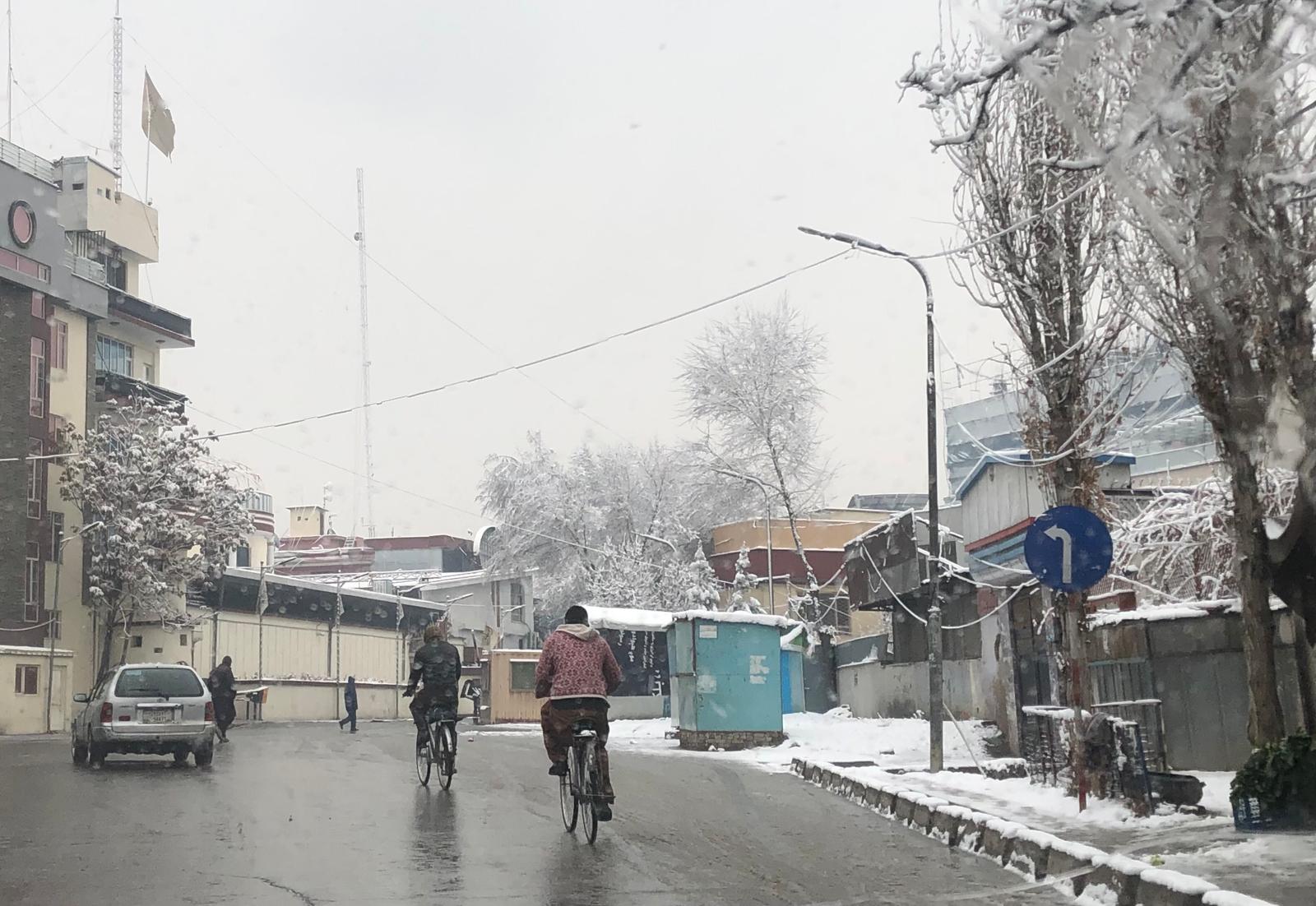
February in Kabul is the coldest month of the year; a month made of power cuts, snowfalls and the hope that there would be enough snow to avert the fear of forthcoming droughts. The first snowfall is always celebrated with an exchange of wishes and sweets.

I wrote about snow in Kabul for the first time more than ten years ago. Now I am back in the city after a very long time and there is snow again and I have the impression of closing an old circle while opening a new cycle.

Never like in this conjuncture, a return feels more like an arrival. Everything is familiar and yet everything is also to be understood afresh, from scratch; everything is to be looked at with new eyes free of prejudice, without the bias of conclusions reached even before fully comprehending details and premises.

I have been here for more than three weeks, but I write only now because probably it is only now that I have mastered the courage to face the fear of being misunderstood and to embrace the desire to highlight the dissonances that emerge every day against opposite polarising and ideological narratives.

After last night’s snowfall, Kabul is all grey; covered by worn and trampled snow and wrapped by an uncertain sky that doesn’t seem to know if it wants to stay hazy or send more snow. It is all these shades of grey that are the most difficult to represent. As days go by, I realise that shouted truths no longer hold when faced with reality; that rules and exceptions coexist side by side; that fear may turn life into survival; that glimpses of hope and possibility open up among millions of contradictions.

In its brutal beauty, Afghanistan has a unique way to crawl under my skin, to call me back and always give me a reason to return, one more question to chase, an epochal transformation to witness, an opportunity to question myself, my ideas and my prejudices. It is a disarming country, that somehow always leaves me alone and bare in front of myself and the reasons of my choices.

Unknown's avatar

Grigio

Febbraio a Kabul è sempre il mese più freddo dell’anno. Un mese fatto di blackout, di nevicate e di speranza che di neve ce ne sia abbastanza per scongiurare la paura della siccità. La prima nevicata dell’anno qui si festeggia con dolci e scambi di auguri.

Ho scritto per la prima volta della neve a Kabul più di dieci anni fa, essere di ritorno dopo tanto tempo e con la neve mi dà l’impressione di chiudere un vecchio cerchio ed aprire un nuovo ciclo.

Mai come in questo momento, il ritorno è piuttosto un arrivo. Tutto è familiare, ma tutto è da capire da capo; con occhi nuovi, liberi da pregiudizi e da conclusioni tirate ancora prima di comprendere a fondo dettagli e premesse.

Sono qui da più di tre settimane e scrivo solo adesso perché forse solo adesso ho trovato il coraggio di guardare in faccia la paura di essere fraintesa e prendere in mano il desiderio di raccontare le dissonanze che emergono qui ogni momento rispetto a versioni della storia opposte, ma comunque ideologiche e polarizzanti.

Dopo la nevicata di stanotte, Kabul è tutta grigia di neve calpestata e avvolta in un cielo incerto che non sa se rimanere nebuloso o buttar giù ancora neve. Sono tutte queste sfumature di grigio ad essere le più difficili da rappresentare. Più passano i giorni e più mi rendo conto che le verità proclamate non reggono il confronto con la realtà; che le regole e le eccezioni convivono fianco a fianco; che la paura rischia di trasformare la vita in sopravvivenza; e che spiragli di speranza e possibilità si aprono in mezzo alle migliaia di contraddizioni.

Nella sua brutale bellezza, L’Afghanistan ha un modo unico di infilarsi sotto la pelle e richiamare a sé, di far sì che ci sia sempre una ragione per tornare, una domanda da inseguire, una transizione epocale a cui assistere, un motivo per mettere in questione se stessi, le proprie idee e pregiudizi. È un paese disarmante, che in qualche modo lascia sempre soli davanti a sé stessi e alle ragioni delle proprie scelte.

Unknown's avatar

L’odore di Kabul

kabul_tcm233-2366391

Sono appena atterrata a Kabul dopo più di quattro mesi di assenza, la lontananza più lunga in questi cinque anni.

Mi ricordo che una volta il mio amico Ty, che a quel punto mancava da Kabul da un po’, mi aveva chiesto di raccontargli l’odore di Kabul così come mi colpiva appena atterrata. E’ passato qualche anno e mi sono accorta di non averlo mai fatto: meglio tardi che mai.

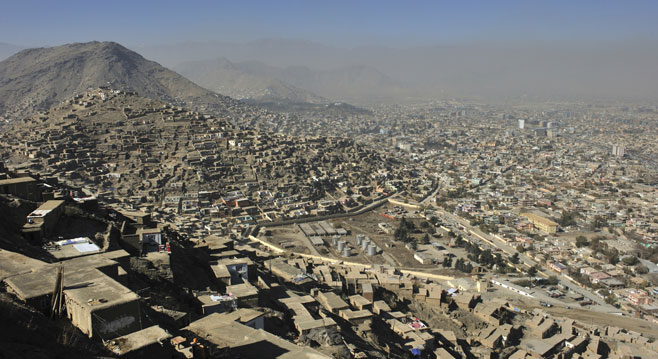
La prima cosa che arriva alle narici, “in corpo e spirito,” è la polvere: che sfrega sull’asfalto, che copre le rose, che crea una patina opaca che offusca la vista. E poi c’è l’odore della plastica che si scioglie: sono le guarnizioni dei finestrini delle macchine che aspettano per ore al sole per via del traffico o della mancanza di alberi. A proposito di traffico, i tubi di scappamento delle vecchie e ammaccate Toyota Corolla contribuiscono non poco alla miscela di effluvi. E poi ci sono gli odori che si costruiscono nella testa: quello che viene dal camion di cocomeri passato all’incrocio o quello di sudore e gioventù nello scuolabus pieno di ragazzine bloccato davanti a me, con i finestrini chiusi nonostante il caldo, e che mi hanno fatto compagnia per buona parte della strada con smorfie e linguacce e risate attraverso il vetro. C’è l’odore dell’estate che finisce e dell’autunno che si insinua con quel retrogusto di umido nell’aria e la previsione del nero pungente del fumo delle stufe a segatura. E infine c’è l’odore del ritorno che, nonostante i dubbi e le esitazioni, ti accoglie come un abbraccio di benvenuto da parte di un vecchio amico.

Unknown's avatar

The photo that wasn’t there

NMA motto copy

Afghanistan National Museum Motto

Yesterday I went for lunch at the Afghanistan Center at Kabul University to see Nancy Dupree. I count the pleasure of her company among the most precious gifts I received from this city. We spent a couple of hours together and we ate an enormous plate of garlic beans and a bowl of sour yogurt.

Nancy is an amazing raconteur and an inexhaustible source of enchanting stories: her intimate knowledge of the country offers, to those who have the privilege to listen, a vertiginous journey across space and time.

Over the years, it never happened to me to spend some time with her and leave without a memorable story to cherish and remember.

Yesterday, when I arrived to her office, she was working on a photo-gallery about the pre-historic tools that are part of the collection of the National Museum. As a cover image for the gallery she wanted to use a photo of the façade of the museum before it was destroyed during the Civil War. She told me she went looking in her extensive photo archive and to her great surprise she could not find any image of that kind. She then went to see the director of the museum to ask him for a copy from their own archives, but he said they did not have any even there. Ever more surprised, she reached out to those who were in town in those years or could have had access to documents of that time. Nothing. It seems that before the Civil War no one considered taking a photo of the façade.

Her story ended there and our conversation moved on, but the thought of the photo that wasn’t there stayed with me.

There are so many moments and details that, there and then, appear entirely unremarkable. There are so many things that we take for granted and let slip away without thinking twice. It is strange to think that these details can then come back unannounced and reveal themselves through their absence in an unexpected future. It is strange to think that they end up becoming witnesses of a past that has left no visual trace.

Unknown's avatar

La foto che non c’era

NMA motto copy

Afghanistan National Museum Motto

Ieri sono stata a pranzo all’Afghanistan Center at Kabul University da Nancy Dupree. Conto il piacere della sua compagnia fra i doni più preziosi di questa città. Abbiamo passato due ore insieme e abbiamo mangiato un piatto smisurato di fagioli all’aglio e una ciotola di yogurt.

Nancy è una grande narratrice e una fonte inesauribile di storie appassionanti, la sua conoscenza intima del paese offre a chi ha il privilegio di ascoltare un viaggio vertiginoso nel tempo e nello spazio.

Nel corso degli anni, non mi è mai capitato di lasciarla dopo un po’ di tempo passato insieme senza una storia memorabile da conservare.

Ieri, quando sono arrivata nel suo studio, stava lavorando ad una galleria fotografica sugli strumenti preistorici conservati al Museo Nazionale. Come immagine di copertina voleva usare una foto della facciata del museo prima che fosse distrutto durante la guerra civile. Nei giorni scorsi ha cercato nel suo archivio fotografico e con sua grande sorpresa si è accorta di non avere nessuna immagine di questo genere. Mi ha raccontato di essere andata a trovare il direttore del museo per chiedere a lui una copia dai loro archivi, ma niente neanche lì. Sempre più sorpresa e incuriosita, ha mandato messaggi e chiamato tutti quelli che in quegli anni erano in città o potevano aver avuto accesso a documenti di quel periodo. Niente. Pare che prima della guerra civile nessuno si sia preoccupato di fare una fotografia alla facciata.

Il racconto è finito lì e la a conversazione ha poi preso un’altra direzione, ma il pensiero di questa foto che non c’è è rimasto con me. Strano pensare a quanti momenti e quanti dettagli là per là non sembrano affatto degni di nota, quante cose diamo per scontate e tralasciamo senza considerazione. Strano pensare come questi dettagli poi possano ritornare e rivelarsi nella loro assenza, in un futuro inaspettato, come testimoni di un passato di cui non restano tracce visive.

Unknown's avatar

No looking away: From Kabul to Kashmir

This article was first published on Kashmir Reader on the 25th of August 2016.
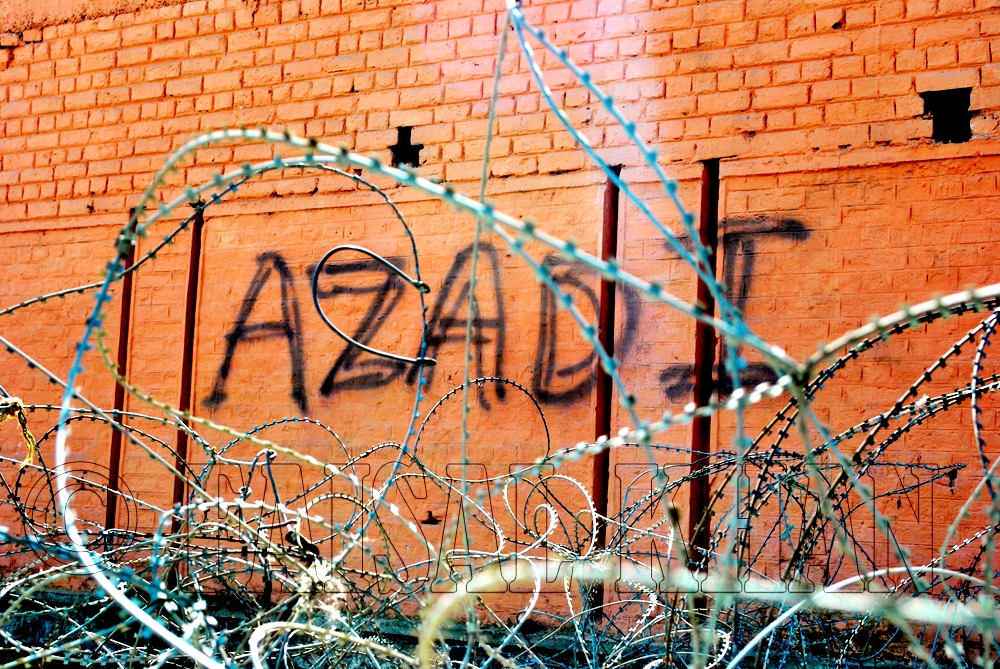
 

AZADII don’t understand those who don’t understand that politics comes also from the belly. Beyond the viscerality of a political existence, there are always contingent factors that, by chance or by necessity, force me to confront the reasons of what I chose, and the values for which I live. There is no looking away.
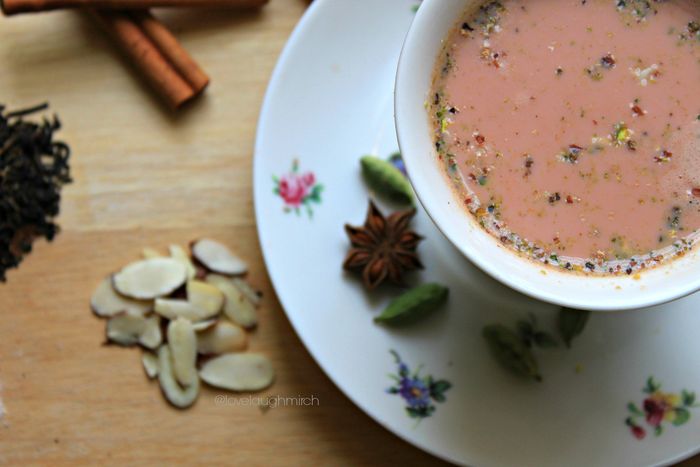
This time the occasion has come from a cup of salty tea, typical of Kashmir and of the Himalayan valleys on either side of the contested border between India and Pakistan.

A couple of days ago I was talking with one of my colleagues, he comes from Hunza, a picturesque and isolated valley 2500 meters above sea level in the extreme north of Pakistan. We were discussing about regional variations in recipes, habits and tradition of the salty tea. As he knows that I like it a lot, after our conversation he made it for me for breakfast. What he calls sheer or shur chai is a version (with butter and without baking soda) of what I know as nun chai and what for me represents the flavour of Kashmir.

Sitting across from each other, we had our tea in silence: our thoughts lost somewhere further East, in two different beautiful valleys of the Himalaya. As I was sipping from my cup, with my body in Kabul and my heart in Srinagar, he filled a bowl with bites of old bread, poured tea over them and ate the whole as a soup, nostalgically thinking of the breakfasts of his childhood.
p2
My cup of sheer chai made me face what I had been avoiding for days.
As I write this I am sitting in Kabul, in a beautiful late summer day that started with an unreported explosion while I was making breakfast. By nature I am not particularly fearful, squeamish or impressionable, and years of work in countries in conflict made my skin pretty thick. Yet, what is happening in Kashmir feels incomprehensible, utterly incommensurable.
It has been for more than forty-six days that I have felt the need to write about the mayhem that has taken over Kashmir, but every passing day made finding the words more difficult. I kept procrastinating, used the fact that I am busy as an excuse and looked away. My guilt, however, kept growing: my silence was becoming a form of complicity. This is the time to speak up, to take sides: the end result of a concerned silence is not different from a lax or irresponsible indifference.
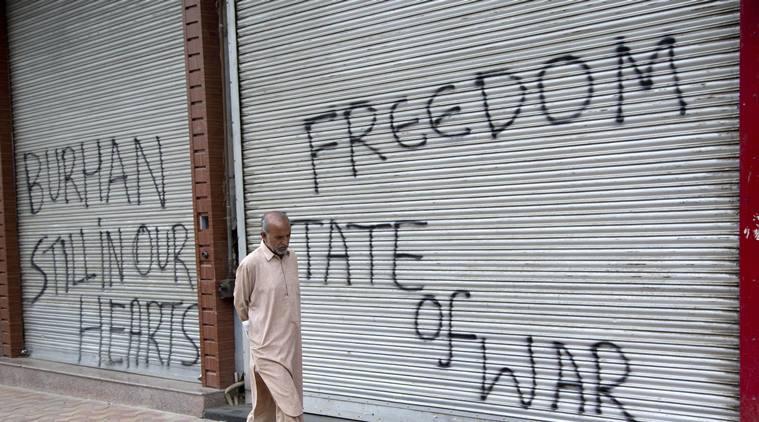
For the past forty-six days the Valley has been under siege. After the killing of Burhan Wani, the young, indigenous, non-Pakistan sponsored, rebel commander fighting against Indian rule in the name of self-determination, Kashmir erupted and took it to the streets. This was by no means unannounced, the rage was simmering and slowly mounting under the surface. Those who cared looking, knew far too well that it was only a matter of time. Nobody, however, could predict that things would escalate to this level.
India responded to protests and stone pelting with an iron fist: with an unprecedented and unimaginable violence. In forty-six days almost seventy people have been killed, at least 6,000 were injured and more than 500 have been hit, mostly in the eye, by pellet guns. Curfew has been extended to both day and night, making it almost impossible even to buy milk. The Border Security Force has once again been deployed in Srinagar, a frightening reminder of the 1990s, certainly not a measure encouraging dialogue. A few days ago the Army prevented the distribution of petrol and an ambulance driver was shot at as he was taking several wounded people to the hospital.
India Kashmir Protests
After the 8th of July, when it became clear that the use of so called non-lethal weapons such as pellet guns would be part of the daily updates, it occurred to me that I had never seen one (why should I after all?) and I could not really grasp how the idea of non-lethal could possibly sit in the same sentence with a firearm. Not knowing how else I could educate myself on the subject, I thought I would check on YouTube. After a bit of browsing, and studiously trying to avoid gory images, I stumbled upon a video shot somewhere in suburban America. The protagonist was a white young man who was defending the efficiency of the pellet gun with spherical projectiles against those detractors who were trying to discredit its firepower. To demonstrate the accuracy of his thesis, he shot at a watermelon at a close range. The fruit cracked open, and the young man showed to the camera with great satisfaction that the watermelon’s inside was smashed beyond recognition.
My heart stopped and I wondered why it was that I did that to myself. I just could not bring myself to think that this was what was happening in Kashmir, to the faces of children as young as five. And not with spherical projectiles, but with modified, irregular pellets that would tear to pieces whatever they would encounter.
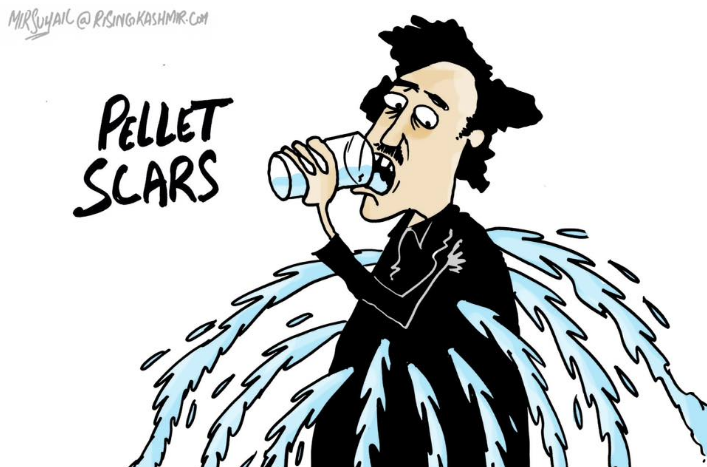
Pellet-scars-Mir-Suhail-Aug-12-2016

Pellet Scars, Mir Suhail

Quite literally, by hitting in the eye, the Indian government forces are not killing people directly, is attempting to kill the idea of the future. It is systematically trying to remove the possibility of looking at the future in a manner that differs from what is envisaged by those in power. This makes me wonder who is it that is really blind: those whom violence have deprived of the sun light or those who think that violence and brutality can kill ideas.
How far can this go? Would an entire population deprived of eyesight stop seeing the way towards freedom, the path to azadi?
I think of my friends, of those who hold a very special place in my heart, of the mothers whose teenage sons are protesting in the streets. I think about the anger, the fear and the right to decide for themselves.
How can one write about all this? Where are the words to be found? The other night a friend told me that there’s no point in writing in times such as these because there is really nothing left to add. Maybe it is true, there are no words to give measure to such a horror and what I am writing is irrelevant, but never like now does silence feel culpable.
At times I wish we’d live in a simpler world where a cup of salty tea could be the trigger to start changing things.
Freedom’s terrible thirst, flooding Kashmir,
is bringing love to its tormented glass,
Stranger, who will inherit the last night of the past?
Of what shall I not sing, and sing?
Agha Shahid Ali
Unknown's avatar

A cup of salty tea

I don’t understand those who don’t understand that politics comes also from the belly. Beyond the viscerality of a political existence, for me there are always contingent factors that, by chance or by necessity, bring me back to the reasons of what I chose and the values for which I live.

Today the occasion has been a cup of salty tea, typical of Kashmir and of the Himalayan valleys on either side of the contested border between India and Pakistan.

A couple of days ago I was talking about it with one of my colleagues, he comes from Hunza a valley 2500 meters above sea level in the extreme north of Pakistan. We were discussing about regional variations in recipes, habits and tradition of the salty tea. As he knows that I like it a lot, he made it for me for breakfast. What he calls shur chai is a version (with butter and without baking soda) of what I know as noon chai and what for me represents the flavour of Kashmir.

As I was sipping from my cup, with my head in Kabul and my heart in Srinagar, he filled a bowl with bites of old bread, poured tea over it and ate it as a soup, nostalgically thinking of the breakfasts of his childhood.

My cup of shur chai made me face what I have been avoiding for days.

It has been for the past forty-three days that I have felt the need to write about what is happening in Kashmir, but every passing day made finding the words more difficult. I kept procrastinating and my guilt kept growing as I felt that my silence was becoming a form of complicity.  

For the past forty-three days the Valley has been under siege. After the killing of a young rebel commander fighting against Indian rule in the name of self-determination, Kashmir took it to the streets and India responded with an iron fist and unprecedented and unimaginable violence. In forty-three days almost seventy people have been killed and hundreds have been hit, mostly in the eye, by pellet guns. Quite literally, the Indian Army is systematically removing the possibility of looking at the future in a manner that differs from what is envisaged by those in power. Over the past few days, curfew has been extended to both day and night, making it almost impossible even to buy milk. The day before yesterday they prevented the distribution of petrol and an ambulance driver was shot at as he was taking several wounded people to the hospital.

I think of my friends, of those who hold a very special place in my heart, of the mothers whose teenage sons are protesting in the streets. I think about the anger, the fear and the right to decide for themselves.

How can one write about all this? Where are the words to be found? Last night a friend told me that there’s no point in writing in times such as these because there is really nothing left to add. Maybe it is true, there are no words to give measure to such horror and what I am writing is irrelevant, but never like now does silence feel culpable.

At times I wish we’d live in a simpler world where a cup of salty tea could be the trigger to start changing things.