Unknown's avatar

Le storie che non si raccontano / The stories that are not told

Per E.P.

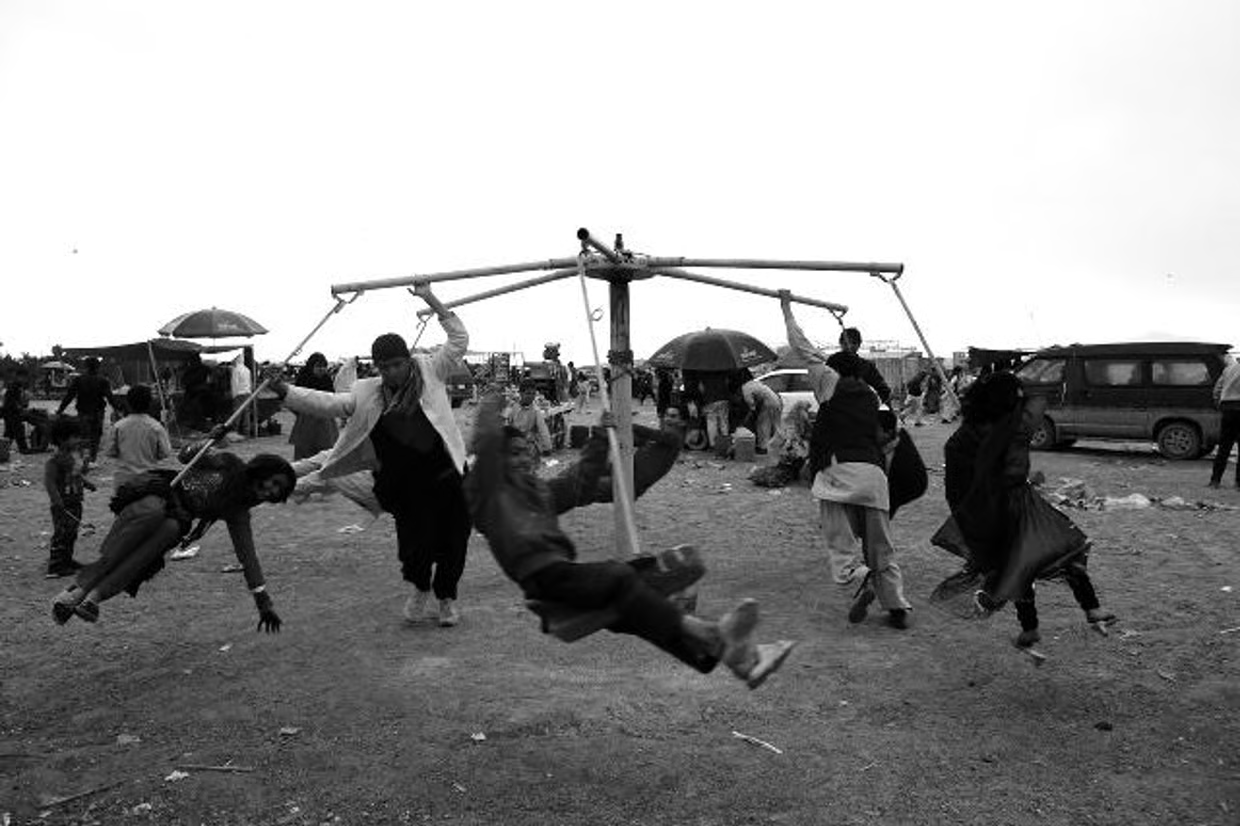
Qualche sera fa parlavo con un caro amico giornalista della difficoltá di raccontare questo paese. L’interesse mediatico per l’Afghanistan è pressoché nullo e quel poco che resta è alimentato da una curiosità morbosa e quasi pornografica per la tragedia. È come se le storie che si raccontano da qui avessero l’unico scopo di confermare il fatto che la “nostra” missione civilizzatrice e la “nostra” volontà di esportare la democrazia non siano fallite per colpa nostra, ma per l’intrinseca intrattabilità di questo popolo.

Le storie tagliate con l’accetta e i titoli sensazionalisti attraggono più attenzione dei tentativi di raccontare le sfumature, che vengono spesso confusi (o ideologicamente manipolati) per apologie di un regime dispotico e teocratico. È una polarizzazione paralizzante che a volte rende quasi impossibile trovare le parole o tessere un filo narrativo per via delle molteplici parentesi che si devono aprire per qualificare ogni parola.

Ci sono poi storie che non si possono raccontare perché c’è bisogno di proteggerle. Gli spazi liminali, i piccoli interstizi, le zone grigie che consentono margini di manovra vanno custoditi e, in questo caso, il silenzio è un piccolo superpotere che garantisce un pochino di invisibilità che fa sì che possano continuare ad esistere. Le storie belle ci sono, ma a volte non si possono raccontare.

La possibilità di queste storie belle è l’ancora del fare. La difficoltà – a volte l’impossibilità – di poterle condividere è un prezzo salato, ma che comunque vale la pena pagare.

Per chi – come me o come il mio amico giornalista – si nutre di parole, la scoperta del valore strategico del silenzio arriva in cima ad una ripida strada in salita. Si tratta di imparare a navigare fra molti veli di Maia, che offuscano e rivelano, che proteggono e dischiudono allo stesso tempo. Si tratta di imparare a dipingere il grigio come spazio di possibilità, come uno spazio controintuitivo di speranza o di fiducia nel fatto che esistono margini di iniziativa anche se non si possono dire ad alta voce.

***

For E.P.

A few evenings ago, I was talking to a dear journalist friend about the difficulty of telling stories about this country. Media interest in Afghanistan is almost non-existent, and what little remains is fuelled by a morbid and almost pornographic curiosity for tragedy. It is as if the stories told from here have the sole purpose of confirming the fact that “our” civilising mission and “our” desire to export democracy have not failed because of us, but because of the intrinsic intractability of this people.

Stories told in broad strokes and sensationalist headlines attract more attention than attempts to tell the nuances, which are often confused (or ideologically manipulated) as apologies for a despotic and theocratic regime. It is a paralysing polarisation that sometimes makes it almost impossible to find the words or weave a narrative thread because of the multiple parentheses that must be opened to qualify each word.

Then there are stories that cannot be told because they need to be protected. The liminal spaces, the small interstices, the grey areas that allow room for manoeuvring must be guarded and, in this case, silence is a small invisibility superpower that allows them to continue to exist. There are beautiful stories here, but sometimes they cannot be told.

The fact that these beautiful stories exist is the anchor of our work. The difficulty – sometimes the impossibility – of being able to share them is a hefty price, but one that is still worth paying.

For those – like me or my journalist friend – who feed on words, the discovery of the strategic value of silence comes at the top of a steep uphill road. It is about learning to navigate among Maia’s many veils, which obscure and reveal, protect and disclose at the same time. It is about learning to discover grey as a space of possibility, as a counter-intuitive space of hope, a space of trust in the fact that there is room for manoeuvring, even if it cannot be said out loud.

Unknown's avatar

Di modelli e miti / On role models and myths

Photo Credit: Dante Korda

È un po’ che ho cominciato un percorso di lettura che mi sta riportando alle origini. Le storie della Resistenza, il confino di Ventotene, la biografia di Che Guevara, l’amicizia in carcere di Gramsci e Pertini.

È un percorso nato per caso, ma sicuramente non casuale; risponde a un gran bisogno di radici, alla necessità di un’ancora e di un orizzonte in un momento di profondo disorientamento politico.

Quelli che nello scenario internazionale sono oggi considerati leader sono in realtà ciarlatani, variazioni sul tema del bullo di periferia, volgari e millantatori, con un ego fuori misura che li porta nella sfera del mito – nel senso di quel territorio sfumato che mescola la realtà e la finzione. Un mito che celebra il culto della violenza, del successo del più forte, dell’egoismo e del vantaggio personale. Seguiti da molti, troppi, che hanno smesso di usare il cervello e di interrogare le proprie coscienze.

Quindi forse è tempo di liberarsi dei miti e di ritornare ai modelli. Un processo silenzioso, ma militante; consapevole e determinato. Un percorso in cui si ritrovano esempi che fanno da guida e aiutano a trovare la strada.

Nel libro sull’amicizia fra Gramsci e Pertini gioca un ruolo importante il dilemma rispetto alla fuga dal carcere. Tema metaforicamente impellente in questo presente disorientante dove il ritirarsi nel sé e fuggire dalla dimensione politica sembra l’unica soluzione saggia e sensata. Eppure per Gramsci e Pertini il dilemma non esiste, esiste solo la fedeltà ai valori e gli ideali che determinano la loro umanità. Solo coerenza e integrità rispetto alle proprie scelte.

Questo mio ritorno alle origini non è dunque anacronistico; al contrario, si sta rivelando una lente importante per guardare al presente. Per ritrovare motivazione e determinazione rispetto a ciò che ho scelto come sostanza del mio stare al mondo. Per ricordarmi che la libertà va coltivata e costruita ogni giorno. Per ricordarmi che non bisogna aver paura di sporcarsi le mani. Per ricordarmi che l’altruismo (altra parola desueta) e la solidarietà non sono opzioni, ma cardini imprescindibili da nutrire e curare.

Che i modelli ritornino dunque ad essere esempio, ispirazione e guida in un tempo di mare in tempesta – bussola e azimut per non perdere l’orientamento.

***

It has been a while since I embarked on a reading journey that is taking me back to my roots. Stories of the Resistance, the Ventotene confino, Che Guevara’s biography, the friendship between Gramsci and Pertini in prison.

This journey began by chance, but it is certainly not random; it responds to a need for grounding, for an anchor, for a horizon at a time of profound political disorientation.

Those who are now regarded as leaders on the international stage are in reality charlatans, variations on the theme of the suburban bully, vulgar and boastful, with an outsized ego that propels them into the realm of myth – in the sense of that blurred territory where reality and fiction merge. A myth that glorifies the cult of violence, the success of the strongest, selfishness and personal gain. These myths are followed by many – too many – who have stopped using their brains and questioning their consciences.

So perhaps it is time to abandon these myths and return to role models. A quiet yet militant process; conscious and determined. A journey where we can rediscover role models to guide us and help us find our way.

In the book on the friendship between Gramsci and Pertini, the dilemma of escaping from prison plays an important role. This is a metaphorically pressing theme in our disorienting present, where retreating into oneself and escaping from the space of the political seems the only wise and sensible solution. Yet for Gramsci and Pertini, there is no such dilemma; there is only loyalty to the values and ideals that define their humanity. In reality, there is no dilemma; there is only coherence and integrity in relation to their choices.

This return to my roots is therefore not anachronistic; on the contrary, it is proving to be an important lens to understand the present. To regain motivation and determination with regard to the way I have chosen of being in the world. To remind myself that freedom must be looked after and built every day. To remind myself that I should not be afraid of getting my hands dirty. To remind myself that altruism (another outdated word) and solidarity are not optional, but essential cornerstones that must be constantly nurtured and cared for.

May role models therefore once again serve as examples, sources of inspiration and guides in times of turbulent seas – a compass and a azimuth to ensure we do not lose our way.